Jaw crusher PE200X300 (3)
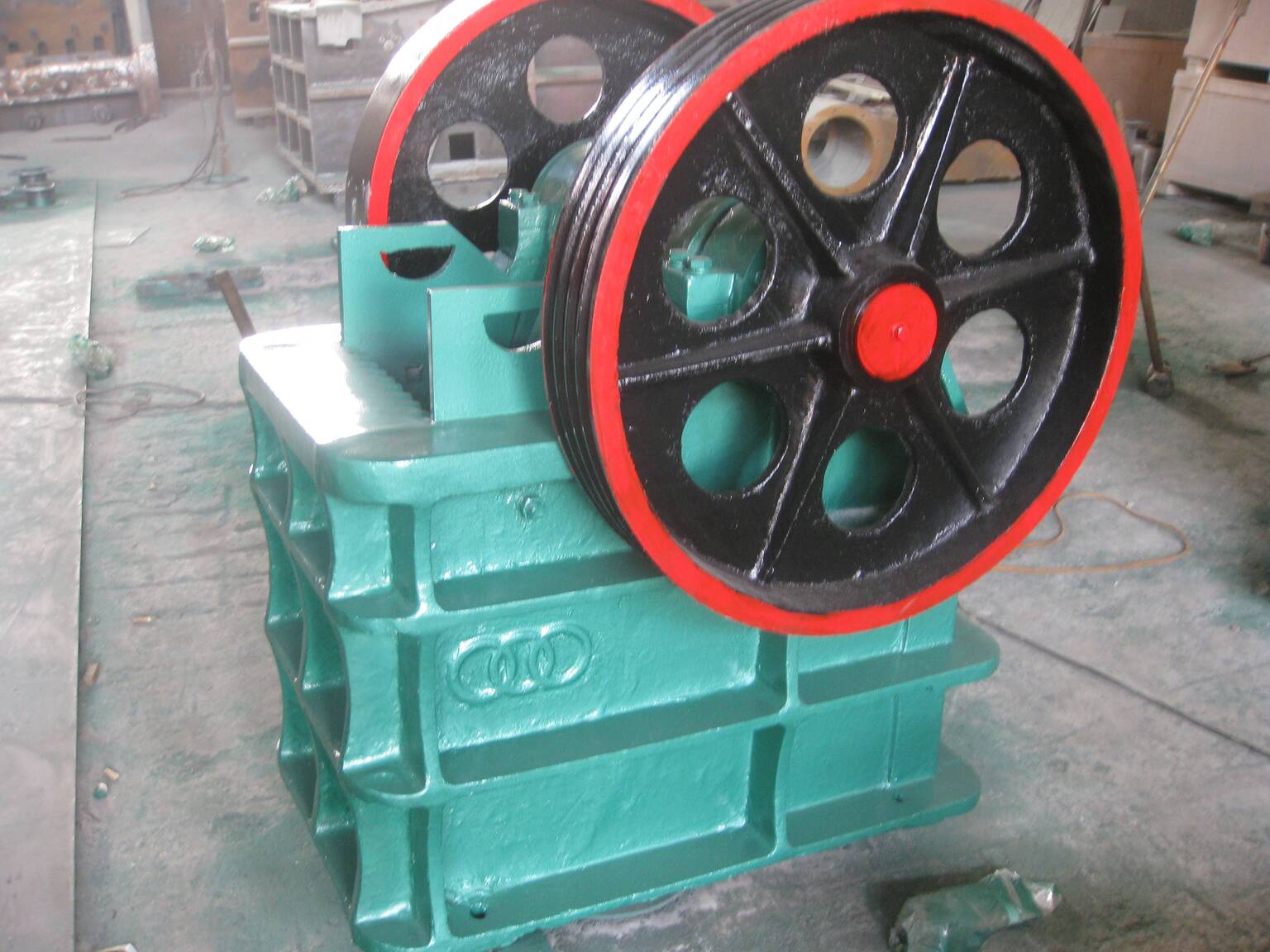
The PE200×300 jaw crusher is a compact, robust primary crushing machine designed for small-scale mining and quarrying, featuring a heavy-duty cast iron frame and a belt-driven system highlighted by large pulleys with red rims. As the first stage in size reduction, it uses an oscillating fixed and moving jaw mechanism to break down raw ore—such as coal, limestone, or metal minerals—into manageable pieces ranging from 10 to 200mm, making it an affordable, easy-to-operate, and maintenance-friendly solution ideal for budget-conscious operations where simplicity and durability are prioritized over complex automation.
Jaw crusher PE200X300 (3)
The image shows a PE200×300 Jaw Crusher, a compactprimary crushing machine commonly used in small-scale mining, quarrying, or industrial applications. The crusher is painted teal (greenish-blue) with large black pulleys featuring red rims — these are part of its mechanical drive system.
🔍 Image Description:
- Main Body: Heavy-duty cast iron frame, robust and boxy in design, indicating it’s built to handle high impact and vibration.
- Pulleys: Two large counterweight pulleys mounted on top — one clearly visible in the foreground. These are part of the belt-driven mechanism that transmits power from the motor to the eccentric shaft, which drives the jaw motion.
- Red Accents: The red rim on the pulley and red center hub likely serve as safety or alignment markers, and may also be for aesthetic contrast.
- Setting: Appears to be inside a workshop or factory floor — concrete floor, tools, and other machinery parts in background, suggesting this unit is either newly assembled or being prepared for shipment.
- Model Marking: “PE200×300” indicates:
- PE = Jaw Crusher model series (commonly used in China and similar markets).
- 200×300 = Feed opening dimensions: 200mm wide × 300mm deep — suitable for medium-sized rocks or ores.
⛏️ How It’s Used in Mining:
The PE200×300 Jaw Crusher is primarily used as a primary crusher in mining operations — meaning it’s the first stage of size reduction after excavation.
✅ Key Functions:
- Breaks Down Large Rocks: Takes raw ore or rock (e.g., coal, limestone, granite, iron ore, copper) fed directly from a loader or conveyor and crushes it into smaller, manageable pieces.
- Reduces Size for Secondary Processing: Outputs material ready for secondary crushers (like cone or impact crushers) or screens.
- Simple & Durable Design: Ideal for small to medium mines where budget and maintenance simplicity are priorities. No complex hydraulics or electronics — mostly mechanical.
🔄 Working Principle:
- The crusher uses two jaws: a fixed vertical jaw and a moving horizontal jaw (driven by the eccentric shaft via the pulley system).
- As the moving jaw oscillates back and forth against the stationary jaw, rocks are crushed by compression between them.
- Material is fed at the top and exits through the bottom when the gap opens sufficiently.
💡 Typical Applications in Mining:
- Coal Mining: Crushing run-of-mine coal before cleaning or transport.
- Aggregate Production: Crushing granite, basalt, or limestone for construction aggregates.
- Metal Ore Processing: Pre-crushing copper, gold, or iron ore before grinding mills.
- Quarry Operations: Reducing blasted rock for further processing or sale as aggregate.
📏 Specifications (Typical for PE200×300):
- Max Feed Size: ~200–250 mm
- Output Particle Size: Adjustable, typically 10–200 mm
- Power Requirement: ~15–22 kW (depending on configuration)
- Weight: ~800–1,200 kg
- Installation: Simple bolt-down base; often powered via belt drive from electric motor
🏭 Why This Model?
The PE200×300 is popular among small-scale miners because:
- It’s affordable and easy to maintain.
- Requires no special skills to operate.
- Can be powered by standard industrial motors.
- Suitable for portable or semi-fixed setups.
It’s often seen in artisanal or small-scale mining (ASM) operations, especially in developing countries, where large-scale automation isn’t feasible.
💬 In Summary:
This jaw crusher is a workhorse of small mining operations — breaking down big rocks into usable sizes using simple mechanical power transmitted through those big red-rimmed pulleys. Its rugged design and straightforward operation make it ideal for environments where reliability and cost-effectiveness matter more than automation or precision.

 Telegram at username
@rcdrun
Telegram at username
@rcdrun WhatsApp Business