- How We Manufacture Parts — Start Your Own Gold Mine
How We Manufacture Parts — Start Your Own Gold Mine
SYOGM GOLD EXPLORATION · Butanaziba Business Center, Kyebando Ring Road, Kyebando, Kampala, Uganda Founder of the method: Jean Louis · Business Owner: Racheal Narabz Nabutono www.StartYourOwnGoldMine.com
This document is the manufacturing doctrine of Start Your Own Gold Mine: what we build, how a part goes from a parametric script to a machine running gold on a Ugandan hillside, and the rules that make the difference between a machine and a pile of welded steel.
1. What we build
Everything is plate-and-structural-steel fabrication designed for a local workshop: a CNC burning table, a plate roll, an angle grinder, and a welding bay. If the Kampala-Uganda workshop cannot cut, roll, and weld it with common tooling, the design is wrong — redesign, don’t outsource to precision you cannot maintain.
The product line
| Family | Examples | Where it works |
|---|---|---|
| Impact mills | HexaMill / OctaMill Astrid — hexagonal upper hull, half-circle bottom hull, 5 static breaker plates around a spinning rotor | Hard-rock fine grinding ahead of recovery |
| Crushing circuit | Jaw crusher (primary), SYOGM Secondary Rock Crusher | 6–10 t/h hard rock circuit (Hard Rock Express program) |
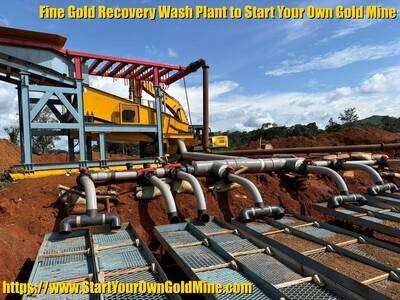
| Trommel wash plants | SYOGM 2026-05 — 50 t/h, 12-sided drum, ~190 cm Ø, 10 mm plate | Alluvial processing, stationary or skid-mobile |
| Classifiers & mills | Classifier wheel (closed-loop 100-mesh), Rothensteed Rock Impact Mill (2 t/h hard rock) | Closed-circuit milling |
| Sluices & recovery | 2-side and 3-side sluice boxes (equal or unequal walls), SYOGM Fine Gold Recovery System #2026 (Prospector’s Sluice, 50/100 mesh sieves, Cleangold multi-stage panning) — recovery down to sub-100 mesh | Gravity concentration |
| Structure & ancillary | Hoppers, catch trays, spray bars, discharge chutes, distribution chambers, skids with tow lugs, conveyor frames, mobile workspace/toilet/mini-container units | Plant support and site infrastructure |
Design signature
- Flat-packed. Machines ship as cut plate, rolled shell sections, and face plates — assembled on site. No castings, no machined assemblies, nothing a village fabricator can’t repair with electrode and grinder.
- Parametric. One script per part family regenerates the entire machine at any size. Today’s 482 mm mill and tomorrow’s 900 mm mill come from the same file.
- Mercury-free, cyanide-free — always. Our entire recovery philosophy is gravity: sluice, matting, panning, Cleangold. Any use of mercury is strictly forbidden; this is a contract condition, not a suggestion.
2. The pipeline — script to steel
argparse script ──► timestamped run dir ──► PNG work orders + flat .step profiles
                                                │                    │
                                          welder at bench      CNC burning table
                                                │                    │
                                                ▼                    ▼
                                          rolling / forming    cut plate
                                                │                    │
                                                └──── assembly ──────┘
                                                          │
                                            test at works ─┴─ test at site
                                                          │
                                                  delivery to customer
Stage 1 — Design: parametric, never hand-drawn
Every part family has one standalone Python script (numpy +
matplotlib + build123d). All dimensions in millimetres, all parameters
exposed as long-named CLI flags, defaults that produce a buildable
part. Full conventions in STEP-GENERATION-STYLE.md — the short
version:
- Diameters are inner-first; fits are explicit (shaft openings +3 mm, breaker slots +1 mm, rotor clearance 4–5 mm).
- Roll-formed stock is calculated as π × mid-radius and printed on the drawing.
- Vertices numbered V0…Vn shared between drawing and cut file, so corrections like “V3 left 10 mm” are executable orders.
- Each run drops 2 PNG work orders + 6 CNC
.stepprofiles for a mill, into an auto-timestamped directory that never overwrites history.
The script is the master drawing. If it isn’t in the script, it doesn’t exist. Hand “improvements” at the table are field fixes to be merged back into the script, or they’re gone at the next build.
Stage 2: The drawing pack ships with the metal
Nobody receives a crate of cut plate without the assembly PNG. The drawing states unit count, every face length, every diameter, the plate-to-roll length, and a generation timestamp — it is the work order, signed off “Work order generated on … by Jean Louis.”
Stage 3: Cutting — CNC plate burning
.step files go straight to the plasma/oxy table. Cutting rules from the shop:
- Hulls and drums: 10 mm heavy-duty steel plate (trommel drum, mill hulls).
- Breaker plates and high-wear parts: 20 mm.
- Slots for breaker plates burn at plate thickness +1 mm — a plate must drop into its slot cold. If it needs a hammer, the cut is wrong; fix the parameter, not the fit.
- Shaft openings burn at shaft Ø +3 mm — enough for alignment slop, close enough that the bearing sits true.
- Breaker slots burn at the computed tilted geometry (15° from radial, inner tips tilted, outer tips symmetric), corner-compensated so tilted plate corners clear the rotor by the exact design gap.
Stage 4: Forming — the roll
Curved parts start as calculated flat stock. The bottom hull of a mill
is a half-circle rolled from a roll_plate whose length is π ×
mid-radius — printed on both the drawing and the filename
(roll_plate_L788_W300). The roll is set on the mid-diameter
(neutral axis), never inner or outer: roll to the mid-surface and
the plate lands exactly on both. Trommel drums roll into 12-sided
polygons from 10 mm plate — straight facets, indexed and welded on a
jig, so the drum stays round without a lathe.
Stage 5: Welding
The welding standard, non-negotiable on every machine we buy or set up:
- Electrodes: 4 mm low-hydrogen — E7018 / J507 for structural I-beam and plate.
- Current: DC, DCEP (electrode positive), 140–180 A for 4 mm at structural plate.
- Machine features required: Hot Start, adjustable Arc Force, Anti-Stick. No exceptions — the plants run on generators with rough arcs, and these three functions are the difference between a clean root pass and a stuck rod.
- Weld gaps are designed in. Ring segments (annular sectors) are cut with a per-edge weld gap (default 2 mm);
--compensateinflates the radii so the assembled ring hits target inner/outer diameters after the weld metal goes in. Assembled diameter shrinks by 2 × gap × count if you ignore this — the script says so every run. - Sequence for ring segments: tack on the jig, check the ring’s inner Ø across both axes before heat, weld alternating opposite joints. Fit before weld, always.
- Skid frames: structural I-beam, continuous fillet at tow lugs and mounting points — a 20-tonne plant on poor roads forgives nothing.
Stage 6: Assembly & finishing
- Mills: face plates (V0–V1, V1–V2) butt-weld to the cut hull profile at the machine width; breaker plates drop into pre-burned slots at the designed clearance from the rotor; the opening frame welds around the top opening; the rolled bottom hull closes the machine. Rotor spins true with the 4–5 mm working gaps intact — check by hand-rotation before the welder walks away.
- Wear surfaces get liners: catch trays in 400F wear liner, surge plates at flow transitions, spray bars pre-wash the feed before the trommel.
- Wash plant assembly on skids: 12-sided drum on its drive (2–10 RPM variable), formed hopper with reinforcing and spray bar, distribution chamber for even feed, 12 or 14 sluice boxes at 4 m runs with fine-gold matting, 15 m conveyor (12.5 HP, 80 cm belt) on truss frame, long discharge chutes throwing oversize well away from the plant base — short chutes build a back-pressure pile in front of the excavator and strangle throughput. Everything mounts on heavy-duty steel skids with tow lugs.
- Power: feed pump 8" or 10" diesel; plant on a recommended 100 kW generator (supply option).
- Drive mechanism guarded, inspection covers accessible — the machine must be maintainable by the customer’s own fitter with hand tools.
Stage 7: Testing, payment, delivery
- Testing at our premises: company expense. The machine runs before it ships.
- Testing at the customer’s site: customer expense.
- Equipment is released only when paid. Hard Rock Express: US $22,000 one-time ($12,000 initiates the order, $10,000 before delivery). Trommel wash plant: US $66,000 standard / $88,000 extended (2.44 m extension, dual-excavator feeder) — US $25,000 deposit commences manufacturing, then US $10,000 at each milestone. Payments follow without delay; delayed payment means delayed production. All funds to a Ugandan bank account before the order commences.
- Manufacturing timeline: ~2 months from deposit for the wash plant, subject to parts availability. Program machines ready for operations within ~45 days of company registration and parties on the ground.
- Transport: customer’s account.
- Parts: jaw crusher spares are the customer’s; secondary crusher and Rothensteed mill spares we guarantee for the first 6 months. Site technical support at 50,000 UGX per staff member per day, expenses on the customer; one staff member for the first month at company expense. Full site management available at 1 gram of gold per day.
3. Production math we quote with
From syogm-estimate-wash-plant-production.py — the same parametric discipline applies to promises:
- Baseline 60 t/h per excavator on a 1.8 m³ bucket, scaling linearly with bucket size and excavator count.
- 20 working hours/day, 30 days/month as standard planning assumptions.
- Grams per day = tonnes/hour × grade (g/t) × hours — every production claim traces to these four numbers, never to optimism.
A wash plant quoted at 50 t/h is a 50 t/h plant because the drum, sluice run count, water supply, and conveyor were all sized against that number.
4. Principles
- The script is the master drawing. Design changes live in parameters. A part that can’t be re-generated from its script is a part we can’t rebuild.
- Nothing is overwritten. Every run, every iteration, timestamped forever. The Astrid mill went through 24 script generations and hundreds of drawing outputs in two days; any point of that history is recoverable.
- Design for the workshop that must also repair it. Local plate, local burning, local rolling, local welding. Precision where it spins, simplicity everywhere else.
- Clearances are designed; shrinkage is budgeted; fits are cold. +3 mm shafts, +1 mm slots, drawn weld gaps. If assembly needs heat or force, the script is wrong.
- The drawing pack ships with the part. Whoever welds it sees the assembly PNG — numbered vertices, face lengths, unit count, generation stamp.
- Gravity only. No mercury, no cyanide. The recovery story is water, steel, and matting — legally clean, environmentally clean, contractually enforced (mercury use is grounds for termination).
- Cash flow is part of the machine. Deposits start production; milestone payments keep it moving. This is stated in every quotation, in every shop, in every country.
Sources: Manufacturing/ script library (hexamill-astrid.py, annular-sector.py, sluice and stadium-shape scripts), STEP-GENERATION-STYLE.md, SYOGM Trommel Wash Plant Quotation v3 (2026-08-30), The Hard Rock Express Start Your Own Gold Mine Program documents, syogm-estimate-wash-plant-production.py.
 Telegram at username
@rcdrun
Telegram at username
@rcdrun WhatsApp Business