- Rock Impact Mills in Comminution: Enhancing Gold Liberation and Gravity Recoverable Gold (GRG) Recovery
- Role of Rock Impact Mills in Comminution: Beyond Aggregates
- Enhancing Gold Liberation Through Controlled Impact Fracture
- Why Impact Mills Are Ideal for GRG Recovery
- Case Study: GRG Recovery in a Gold Mine (Western Australia)
- Optimizing Impact Mill Use for Gold Ore
- Environmental and Economic Benefits
- Conclusion: Impact Mills as a Strategic Tool for Gold Liberation and GRG Maximization
Rock Impact Mills in Comminution: Enhancing Gold Liberation and Gravity Recoverable Gold (GRG) Recovery
Rock impact mills—also known as impact crushers or impact pulverizers—are mechanical size-reduction machines that utilizehigh-velocity impact forces to fracture hard, brittle materials such as rock, ore, and mineralized conglomerates. While traditionally associated with aggregate production and secondary crushing, their role in mineral processing—particularly in gold recovery operations—is increasingly recognized as a critical, underutilized step in the comminution circuit. When strategically integrated into a processing flow sheet, rock impact mills significantly enhance the liberation of gold particles and maximize the recovery of Gravity Recoverable Gold (GRG), thereby improving overall ore value and reducing downstream costs.
Role of Rock Impact Mills in Comminution: Beyond Aggregates
Comminution—the process of reducing solid material into smaller fragments—is one of the most energy-intensive and costly stages in mining. The typical comminution sequence in gold ore processing involves:
- Primary Crushing — Usually performed by a jaw crusher, which reduces run-of-mine (ROM) ore from large boulders (up to 1.5 m) to ~150–200 mm.
- Secondary Crushing — Often handled by cone or impact crushers, further reducing material to 25–50 mm for efficient feeding into grinding circuits (ball mills or SAG mills).
- Tertiary Grinding — Ball mills or rod mills reduce material to 75–150 microns to liberate fine gold.
Here’s where rock impact mills shine. When employed as a secondary crusher—especially in hard-rock gold operations—impact mills offer advantages over traditional cone crushers in terms of particle liberation, grain structure preservation, and GRG enhancement.
Enhancing Gold Liberation Through Controlled Impact Fracture
Unlike compression-based crushers (e.g., jaw or cone), which crush material by squeezing between two surfaces and often produce elongated, flaky particles with embedded gold, impact mills fracture ore along natural planes of weakness—cleavage lines, fractures, and mineral boundaries. This results in:
- More uniform particle size distribution with fewer fines (which can trap gold or hinder gravity separation).
- Improved liberation of gold grains, especially free-milling and coarse gold particles, because the impact force tends to split along host rock-mineral interfaces rather than grinding gold into fine, encapsulated particles.
- Preservation of GRG: Gravity Recoverable Gold (GRG) refers to free gold particles that can be recovered by gravity methods such as jigs, shaking tables, or centrifugal concentrators. These particles typically range from 75 microns to several millimeters in size. Impact mills reduce the risk of overgrinding and “smearing” of gold into fine sulfide matrices, preserving the gold’s natural form and density for efficient gravity recovery.
Studies from operations in Australia, Canada, and West Africa have shown that replacing secondary cone crushers with Horizontal Shaft Impact (HSI) mills in gold circuits can increase GRG recovery by 8–15%, simply by reducing unnecessary abrasion and preserving coarse gold fragments.
Why Impact Mills Are Ideal for GRG Recovery
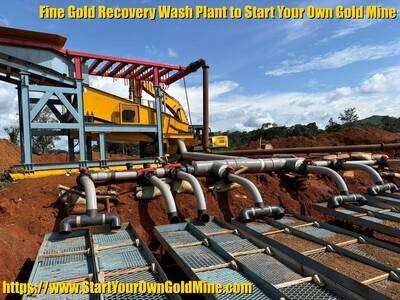
Gravity separation methods (e.g., Cleangold, SYOGM Fine Gold Recovery System, Knelson concentrators, Falcon concentrators, gold tables) are highly effective for recovering coarse and medium-grained free gold, but they are inefficient with fine, liberated gold particles or gold locked in fine matrices. Here’s how impact mills optimize the process:
| Factor | Jaw/Cone Crusher | Rock Impact Mill |
|---|---|---|
| Particle Shape | Elongated, flaky | Cubical, angular |
| Liberation Efficiency | Moderate; gold often remains locked | High; fractures along mineral boundaries |
| Fines Generation | High (especially with cone) | Lower; controlled breakage |
| GRG Preservation | Poor; gold gets abraded into matrix | Excellent; coarse gold survives impact |
| Downstream Grinding Load | Higher (more regrind needed) | Lower (better feed for grinding) |
By delivering a more liberated, less over-ground feed to ball mills or rod mills, impact mills reduce the energy required for tertiary grinding and minimize the formation of ultra-fine (sub-10 micron) gold, which is nearly impossible to recover via gravity.
Case Study: GRG Recovery in a Gold Mine (Western Australia)
A mid-sized gold mine in Western Australia replaced its secondary cone crusher with a high-efficiency HSI mill (2019) to process a quartz-carbonate-hosted ore body containing visible gold. Prior to the change, GRG recovery was averaging 62% of total gold, with significant losses in cyclone underflow and tailings. After implementation:
- Feed size to ball mill reduced from 35 mm to 18 mm, lowering grinding energy by 12%.
- GRG recovery increased to 78%—a 16% relative improvement.
- Overall gold recovery rose from 88% to 94%, with a 10% reduction in cyanide consumption due to fewer locked gold particles.
- The mine reported a $1.2M annual increase in gold value from GRG alone, with a 6-month payback on the HSI mill investment.
This success led to industry-wide recognition of impact mills as a “GRG-enhancing” tool—not just a size-reduction device.
Optimizing Impact Mill Use for Gold Ore
To maximize GRG recovery, operators should consider:
- Rotor Speed Adjustment: Lower RMP settings (e.g., 600–800 RPM) reduce over-crushing and preserve coarse gold.
- Hammer Material: Use high-toughness, high-chrome alloy hammers resistant to impact fatigue but not overly abrasive—minimize contamination.
- Screen Size Selection: 10–25 mm discharge screens are optimal to maximize liberation while retaining GRG particles.
- Integration with Pre-Sorting: Combine with sensor-based ore sorting (e.g., XRT or laser sorting) to reject barren rock before crushing, reducing unnecessary energy use and improving GRG concentration.
- Hybrid Circuits: Use VSI mills for final “conditioning” of crushed product to enhance sand-like particle shape for gravity circuits without introducing excessive fines.
Environmental and Economic Benefits
- Lower Energy Consumption: By reducing the need for extensive grinding, impact mills lower electricity use by 10–20% per tonne of ore.
- Reduced Chemical Use: Better gold liberation means less cyanide and reagent consumption in leaching.
- Waste Reduction: Higher GRG recovery reduces gold loss to tailings, improving sustainability and regulatory compliance.
- Asset Flexibility: Impact mills can be used in both primary and secondary stages, making them ideal for modular or mobile processing plants in remote goldfields.
Conclusion: Impact Mills as a Strategic Tool for Gold Liberation and GRG Maximization
Rock impact mills are far more than aggregate crushers. When intelligently deployed in the comminution circuit—particularly after jaw crushing and before grinding—they become powerful tools for enhancing gold liberation and maximizing Gravity Recoverable Gold (GRG). By fracturing ore along its natural weaknesses and minimizing the generation of harmful fines, impact mills preserve the physical integrity of gold particles, enabling gravity concentrators to recover vastly more gold than traditional compression-based crushing allows.
In an industry where even a 1–2% increase in gold recovery can mean millions in additional revenue, the strategic integration of rock impact mills into gold processing flowsheets represents a low-cost, high-return innovation. As mining operations increasingly prioritize efficiency, sustainability, and GRG optimization, impact mills are poised to transition from secondary equipment to a core component of modern, high-recovery gold plants.
In short: For gold, it’s not just about grinding—it’s about breaking smart. Rock impact mills help you do just that.
 Telegram at username
@rcdrun
Telegram at username
@rcdrun WhatsApp Business