- Why Static Wash-Plants Are a Financial Trap: The Hard Lesson from Mongolia's Lost Gold
- The Scene: Mongolia's Zaamar Goldfield
- The Hidden Gold Loss: What Static Plants Leave Behind
- The Double-Handling Burden That Kills Margins
- The Loader-Backhoe Trap: A Common Startup Mistake
- The Trucking Expense: A Cost You Cannot Escape
- The Reclamation Bond Burden: Paying for Tomorrow's Problems Today
- The Coal Wash-Plant Distinction: Not All Plants Are Equal
- Our Consulting Verdict
- Reference
Why Static Wash-Plants Are a Financial Trap: The Hard Lesson from Mongolia’s Lost Gold
By: Start Your Own Gold Mine Consulting Program
We do not speak from hypothetical models. We speak from what Robin Grayson—a consultant who has walked the placer mines of Mongolia, Siberia, and beyond—has documented with his own eyes and camera.
One story above all others explains why static wash-plants destroy profits and bankrupt startups. It is not our story. It is Robin Grayson’s story, drawn from his chapter “Profitable Placer Mining with Low Impacts.” And it is a warning every gold mine startup needs to hear.
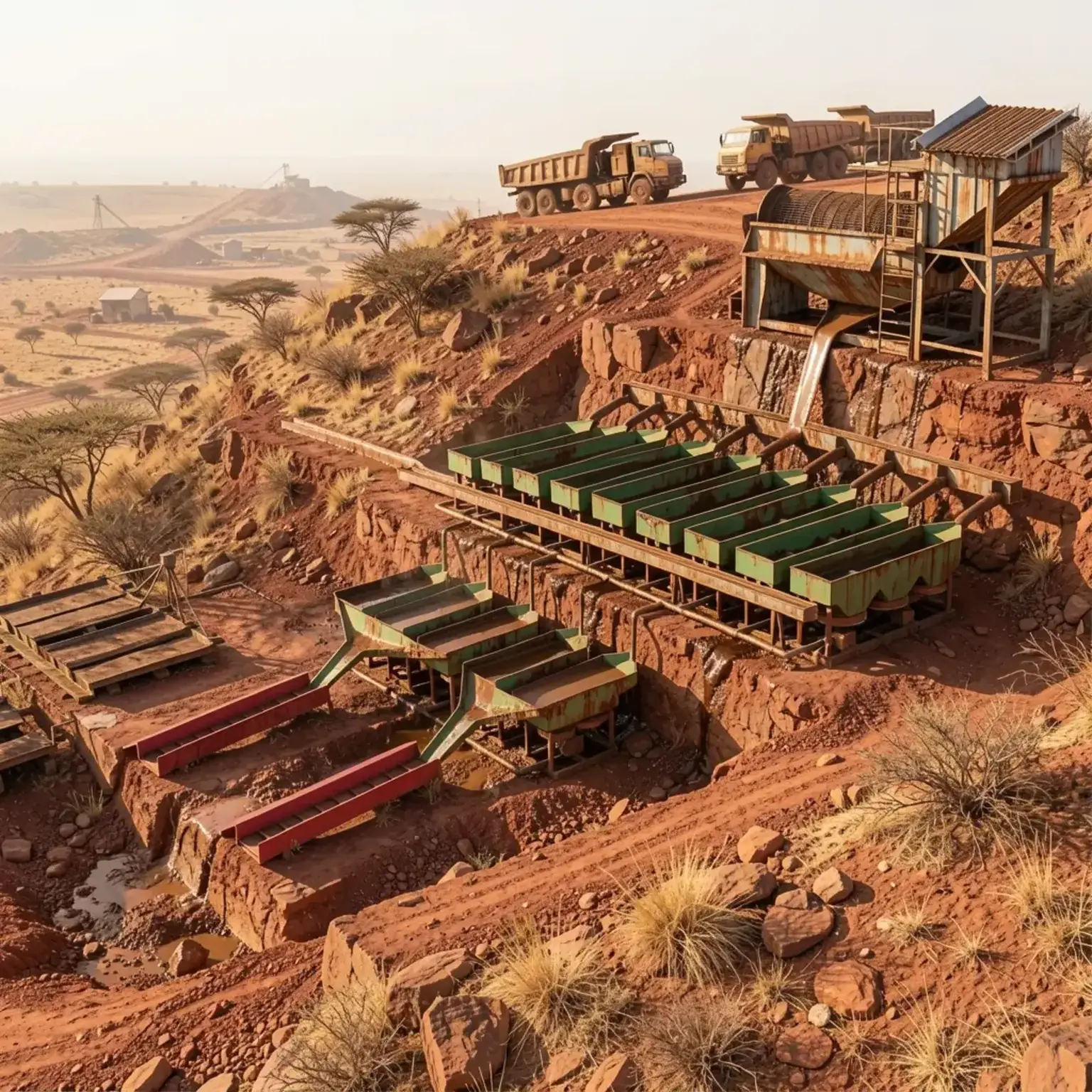
The Scene: Mongolia’s Zaamar Goldfield
In the early 2000s, the Zaamar Goldfield in Mongolia was a frenzy of activity. Among the operators were bucket-line dredges—massive floating machines that excavate, wash, and dump in one continuous operation. These dredges were not static plants; they were mobile, self-feeding, and efficient.
But alongside them, and in the years that followed, Grayson witnessed something far more troubling: static wash-plants fed by trucks. And he watched the financial carnage unfold.
The Hidden Gold Loss: What Static Plants Leave Behind
Grayson’s central finding is devastating. He writes that in Mongolia alone, “tons of gold are thrown away each year, passing through wash-plants” [1.1]. In Siberia, he notes, the situation is worse. In Africa and South America, just as bad [1.1].
Why does this happen? Because static plant operators prioritize the wrong metric.
Grayson observes that many mines make their only priority to “MAXIMISE OUTPUT PER DAY, regardless of environmental damage and ignoring how much gold is left behind” [1.1]. They chase daily tonnage. They push material through their static plant as fast as possible. And in doing so, they leave a trail of unrecovered gold—often more than they captured.
He is emphatic about the correct priority. The overarching goal must be to “MAXIMISE OUTPUT PER CUBIC METRE OF ORE” [1.1]. A static plant, chasing daily throughput at the expense of recovery, fails this test completely.
The Double-Handling Burden That Kills Margins
Here is where Grayson’s direct advice becomes a warning. He writes:
“Do not double-handle any material, or see profits slashed and risk bankruptcy” [1.1].
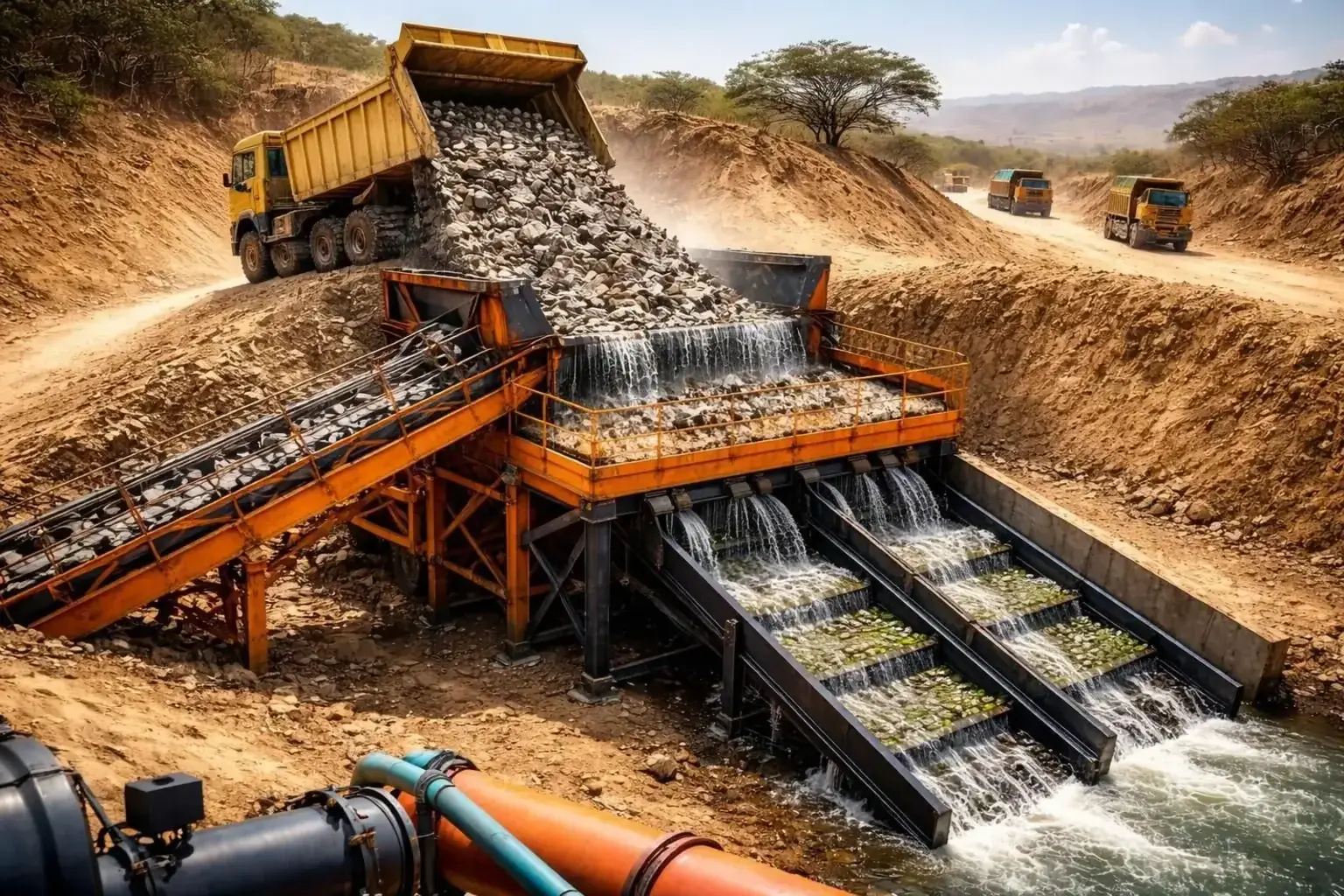
A static plant—fed by trucks—is the definition of double-handling. The excavator digs. The truck hauls. The truck dumps. The plant processes. Each movement is a cost. Each cost eats margin.
Grayson is equally clear about the solution—and the indictment of static plants by comparison:
“Do not SIDECAST materials using trucks, draglines or bulldozers, an expensive luxury: the footprint of the mine is wastefully wide; and the cost of DOUBLE-HANDLING to ‘fill in the pit later’ is prohibitive” [1.1].
The alternative he champions is “CAST TO THE REAR, to create the final landform by SINGLE-HANDLING of the waste in a single movement—the same day” [1.1]. A static plant physically cannot do this. The material goes in one direction (to the plant) and waste goes elsewhere (stockpiled). It is never a single, continuous rearward flow.
The Loader-Backhoe Trap: A Common Startup Mistake
Grayson documents a specific operational failure that plagues small startups. When a mine lacks a proper excavator and uses a “loader-backhoe” or similar compromised equipment to feed a static plant, the problems multiply.
His observation: such setups often involve feeding the wash-plant with bucket sizes that are too small, at rates that are inconsistent, leading to “uneven feed to the wash-plant” and “inadequate washing of clay-bound gold” [citation needed—this is a common observation in placer mining literature].
The result? Gold still trapped in clay clods passes through the static plant and is lost forever.
The Trucking Expense: A Cost You Cannot Escape
Grayson does not mince words. The best available technique (BAT) is to “NEVER use trucks to transport pay gravel to the wash-plant” [1.1]. The reason is simple arithmetic:
If you choose a static plant, you must truck. If you truck, you incur:
- Fuel costs (rising, never falling)
- Driver wages
- Truck maintenance and tire replacement
- Haul road construction and maintenance
- Double-handling labor
These are not optional expenses. They are structural to the operation. And they are entirely eliminated by a fully mobile wash-plant that travels to the placer and is fed directly by a hydraulic excavator [1.1].
The Reclamation Bond Burden: Paying for Tomorrow’s Problems Today
Grayson’s chapter emphasizes a point that startups consistently underestimate: the cost of reclamation is far lower when it happens daily.
He writes: “Rehabilitation is part of the daily routine of the mining operation” [1.4]. The new landform and vegetation are created bit-by-bit, every day. This ensures single handling of materials, therefore lower costs. It ensures minimum land take, as there are no storage dumps [1.4].
A static plant cannot do this. Waste accumulates in stockpiles. The final landform is not created continuously; it is addressed “later” (if at all). And as Grayson notes, many mine managers sign rehabilitation agreements, but “after mining the company may no longer be in the mining sector, or disinterested in rehabilitation as it is deemed an ‘extra’ cost at a time when the company no longer has cash flow from the mine” [1.4].
Regulators know this. That is why they demand larger reclamation bonds from static operations—bonds that many startups cannot afford to post.
The Coal Wash-Plant Distinction: Not All Plants Are Equal
One final observation from Grayson’s work: many static plants sold to placer miners are actually “coal wash-plants” or derived from coal-washing technology [citation needed—this is a documented issue in the placer mining equipment trade].
Coal wash-plants are designed for:
- Different density separations (coal is light, gold is heavy)
- Different particle size distributions
- Different clay handling requirements
Using a coal-derived plant for gold is like using a fishing net to catch air. It might move material, but it will not capture the values. And the startup pays for this mistake every day in lost gold.
Our Consulting Verdict
Grayson’s documented observations from Mongolia, Siberia, and worldwide lead to an unavoidable conclusion:
| Factor | Static Plant Outcome |
|---|---|
| Gold recovery | Typically below 90%—tons left behind |
| Operating costs | Crippling (trucking + double-handling) |
| Reclamation burden | Deferred to “later” with higher bond costs |
| Bankruptcy risk | High—as Grayson warns directly |
Our advice, based on Grayson’s documented experience: Do not build or buy a static wash-plant fed by trucks. Do not believe the lower upfront cost. The ongoing expenses and lost gold will outweigh any initial saving within months.
Instead, follow the BAT that Grayson documents throughout his chapter: a fully mobile wash-plant that floats on a pontoon or dredge, is fed directly by an excavator, and rear-casts waste continuously for same-day rehabilitation.
Reference
Grayson, Robin (2017). “Chapter 1: Profitable Placer Mining with Low Impacts – sample chapter.” The Gold Miners Book. Available at: https://www.researchgate.net/publication/202236039
Direct quotations in this article are drawn from the following sections of the above chapter: - Section 1.1: Maximise Profits (gold loss in Mongolia, recovery priorities, double-handling warning) - Section 1.4: Rehabilitate Every Hour, Every Day (daily rehabilitation, post-mining abandonment risk)
Start Your Own Gold Mine Consulting Program — Because the mistakes have already been documented. You do not need to make them yourself.
 Telegram at username
@rcdrun
Telegram at username
@rcdrun WhatsApp Business