Wash plant in Congo
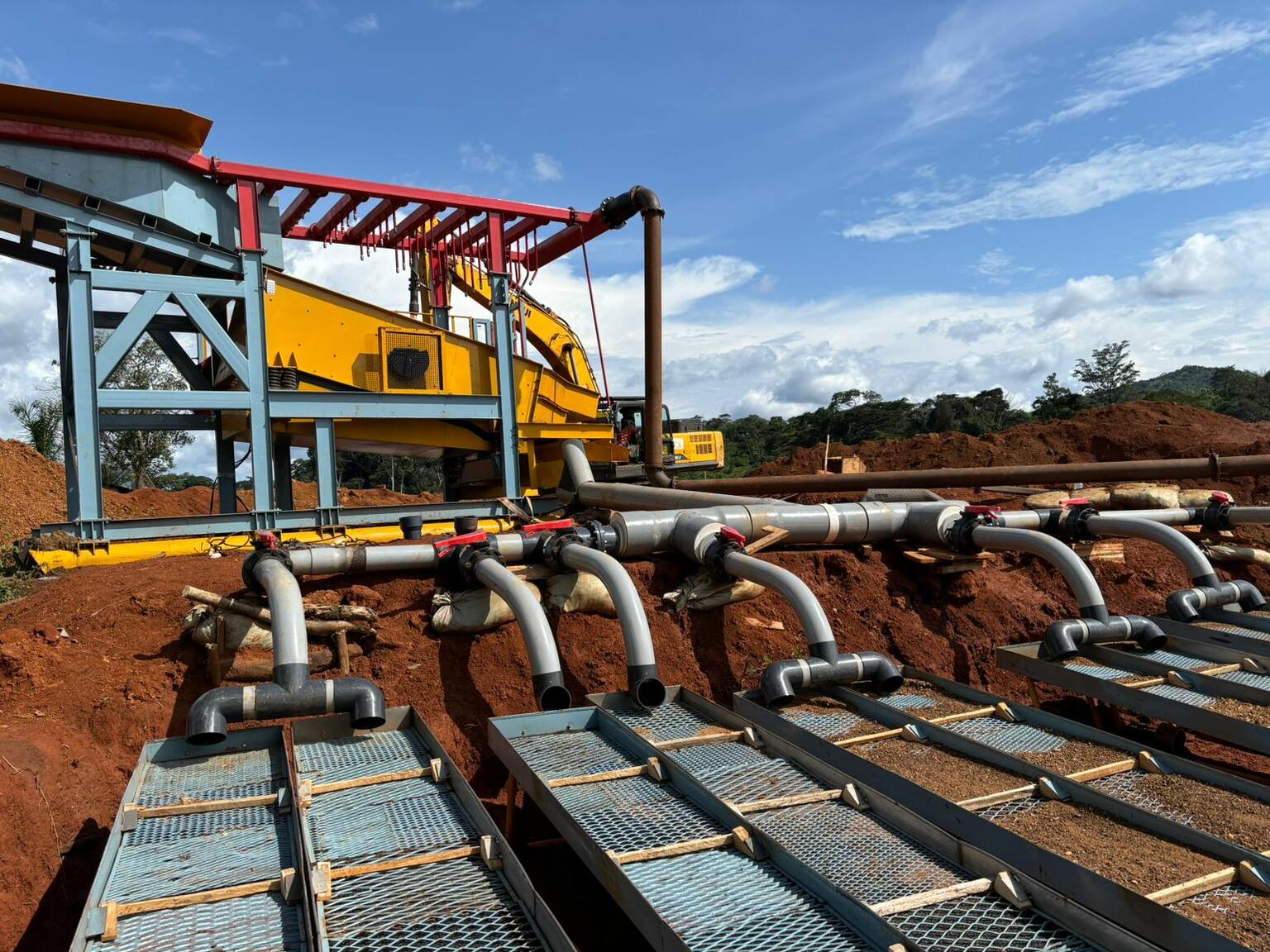
Set against the vivid backdrop of the Democratic Republic of the Congo's red earth and distant green hills, this image captures a modern, large-scale mining operation bathed in bright blue skies. The scene is anchored by a sophisticated industrial wash plant, meticulously designed by Jean Louis. Dominating the mid-ground, a massive yellow excavator is integrated into a robust blue and red steel structure, likely serving as the heart of a conveyor or processing system. In the foreground, a complex network of grey pipes snakes across the excavation, fitted with distinctive red-handled valves and positioned above metal grates or sluice boxes. This setup illustrates an active hydraulic system, where water flows to separate valuable minerals from the reddish soil piled around the site. The combination of heavy machinery, intricate piping, and the stark contrast of the red earth creates a dynamic portrait of earth-moving and mineral extraction in a tropical environment.
Wash plant in Congo
Overview
The SYOGM Advance Wash Plant is an innovative, mobile gold recovery system designed for alluvial (placer) mining. Developed by Start Your Own Gold Mine (SYOGM), it is engineered toefficiently extract gold particles from dirt and riverbed sediments. The system is scalable, capable of processing anywhere from 30 to 60+ tonnes per hour, and is suitable for both small-scale and .
The design emphasizes efficiency, minimizing unnecessary machinery movements, and maximizing gold recovery through a multi-stage sorting and washing process.
For more information
SYOGM Advance Gold Wash Plant Design: https://www.startyourowngoldmine.com/dpe/planning/equipment/gold-recovery-washplant/SYOGM-Advance-Wash-Plant-Design.html
Key Components and Processes
The wash plant operates as a systematic assembly line where material is progressively separated by size and density to isolate gold.
1. Feeding and Excavation
Excavators: One or more excavators feed the plant, handling approximately 50 tonnes per hour each. Dragline excavators are specifically noted for their ability to dig deep into riverbeds, removing large volumes of overburden directly onto the plant.
Loading Methods: Material can be loaded via conveyor belts or piped directly from dredging operations (for underwater deposits), ensuring a continuous workflow.
2. Pre-Treatment: Wash Hopper
Function: This is the entry point where raw dirt is introduced.
Mechanism: It features 50 to 100 spray nozzles on its walls and frame. These jets disintegrate the soil clumps before they enter the main system.
Design: The hopper is sloped (15°–20°) to utilize the angle of repose and includes a detachable mechanism for easy maintenance.
3. Sizing: Primary Grizzly Bars
Function: Separates oversized rocks (>½ inch) from smaller particles.
Mechanism: Vibrating bars spaced at ½ inch allow fine material to pass through while larger rocks are diverted.
Recovery Note: Even rocks rejected at this stage may contain gold; the design suggests these should be further processed later rather than discarded entirely.
4. Screening: Screen Units
Function: Further refines material.
Mechanism: Uses wire rope with a 3 mm (approx. 1/8 inch) gap.
Output: Discards particles between 3/8" and ½", allowing only material smaller than 3/8" to proceed.
Purpose: Uniform particle size is crucial for the subsequent sluicing phase to prevent fine gold from being trapped with larger rocks.
5. Collection: False-Bottom Box & Funnel
False-Bottom Box: A primary gold collector that traps fine particles and gold while releasing larger debris. Vibrations and water spray help gold settle here.
Gold Collection Funnel: Located beneath the false-bottom box, this stainless steel component with dual valves acts as a safety net to catch any gold that might pass through the box. It allows for secure extraction and cleaning without loss.
6. Distribution & Recovery Sluices
The material smaller than 3/8" is distributed to several sluice systems designed to capture gold based on particle size:
- Gold Recovery Sluices:
- Designed for particles < 3/8".
- Configured in sets of three (totaling nine sluices for large plants).
- Materials: Aluminum sections filled with expanded metal, vinyl loop mats, and vortex matting.
- Note: The design emphasizes that width is more important for recovery than length, preventing gold from being washed away by excessive flow velocity.
- Medium Gold Sluice:
- Targets larger particles (3/8" to 1/1 inch) that bypassed the primary screen.
- Uses aggressive recovery methods to capture medium-sized gold.
- Tailings Sluice:
- A diagnostic tool placed after other sluices to catch any lost gold.
- Should ideally recover no gold; its presence indicates the need to adjust spray bars or slopes in other units.
7. Water Management
- Pumps & Pipes: High-powered pumps provide the necessary flow rate. The system allows for adjustable flow and gravity-fed options where terrain permits to save energy.
8. Post-Processing: Concentrate Room & Finalization
- Concentrate Room: A secure, surveillance-monitored facility where concentrates are upgraded. It handles smelting, assaying, and refining.
- Cleangold Inserts: Advanced inserts inside the sluices capable of capturing fine gold down to 5 microns (invisible to the naked eye).
- Concentrate Buckets: A robust bucket system organizes concentrates by size for inspection and final recovery.
- Final Output: Gold is smelted in induction furnaces, assayed for purity, and stored as cash income.
Operational Philosophy
The SYOGM design philosophy relies on gravity and mechanical separation rather than complex chemical processes. By breaking the ore into specific size fractions and directing them to the appropriate sluice type, the system ensures that gold of all sizes—from visible nuggets to microscopic dust—is captured.
The text also highlights a strong emphasis on security (locked funnels, surveillance rooms) and efficiency (reducing excavator movement, using gravity for water), making it a comprehensive solution for modern artisanal and small-scale gold mining.
For more information
SYOGM Advance Gold Wash Plant Design: https://www.startyourowngoldmine.com/dpe/planning/equipment/gold-recovery-washplant/SYOGM-Advance-Wash-Plant-Design.html

 Telegram at username
@rcdrun
Telegram at username
@rcdrun WhatsApp Business