- Welding a Gold-Wash Plant: Practical Welding Wisdom for Structural Fabrication
- 2. MMA, MIG and TIG: understand the difference
- 3. E7018 is an excellent structural electrode
- 4. What does DCEP mean?
- 5. Why would you ever connect the electrode to MINUS?
- 6. A 400 amp welding machine does not mean you weld at 400 amps
- 7. What machine is needed for a 4 mm electrode?
- 8. Do not use excessive current
- 9. Do you weld the H-beam vertically onto the flange?
- 10. A bigger weld is not necessarily a stronger weld
- 11. Gussets can be more important than a huge weld
- 12. Tack welding and alignment
- 13. Use a balanced welding sequence
- 14. Keep the steel clean
- 15. Do E7018 electrodes need heating?
- 16. Does the 20 mm flange need preheating?
- 17. Never confuse preheating with overheating
- 18. MIG/MAG can also be excellent for structural steel
- 19. MMA versus MIG/MAG for a wash plant
- 20. MIG is particularly useful for aluminum
- 21. Why aluminum requires special MIG equipment
- 22. MIG aluminum normally uses DC electrode positive
- 23. MIG versus TIG for aluminum
- 24. The welding machine is only one part of the system
- 25. Welding a wash plant requires thinking about vibration
- 26. Corrosion protection matters
- 27. A practical welding philosophy for Start Your Own Gold Mine
- 28. The most important lesson
Welding a Gold-Wash Plant: Practical Welding Wisdom for Structural Fabrication
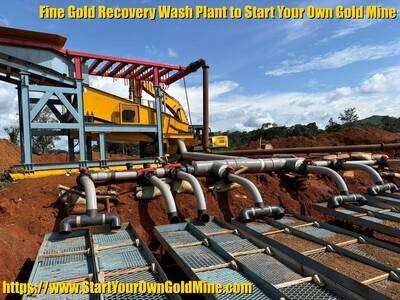
Building a wash plant for alluvial gold recovery is not simply a matter of cutting steel and joining the pieces together. A wash plantis a working machine exposed to vibration, water, slurry, impact, moving material, transport loads and, sometimes, rough operating conditions in remote mining areas.
The quality of the welding therefore matters just as much as the quality of the steel.
For a small-scale gold-mining operation, it is particularly valuable to understand the basic welding principles rather than assuming that a very large welding machine or a very large weld automatically produces a stronger structure.
This article explains practical welding principles for fabricating structural components of a gold-wash plant, including H-beam supports, base plates, brackets, gussets, hoppers, frames and aluminum components.
1. Welding is part of structural engineering
Consider a simple example:
A 280 mm × 280 mm × 20 mm thick steel flange plate has a 200 × 100 mm H-beam welded vertically onto it.
At first glance, this appears to be a simple welding job:
Put the H-beam on the plate and weld around it.
But the real engineering question is:
Can the complete connection safely transfer the forces from the H-beam into the base plate?
The answer depends on much more than the welding machine.
The strength of the connection depends on:
- H-beam dimensions;
- H-beam material thickness;
- flange plate thickness;
- steel grade;
- weld size;
- weld length;
- weld configuration;
- column height;
- vertical loading;
- sideways loading;
- vibration;
- impact;
- structural bracing;
- gusset plates;
- distortion;
- quality of the weld;
- corrosion protection.
A large welding machine cannot compensate for poor structural design.
Likewise, a very large weld does not necessarily make a connection stronger.
2. MMA, MIG and TIG: understand the difference
Three welding processes are particularly useful in fabrication.
MMA — Manual Metal Arc Welding
MMA is commonly called stick welding and is also known as SMAW, Shielded Metal Arc Welding.
The welding electrode is a consumable metal rod covered with a flux coating.
The basic equipment consists of:
- welding machine;
- electrode holder;
- work/earth clamp;
- welding electrode.
The electrode creates an electric arc with the workpiece. The arc melts the electrode and the base metal. The electrode coating produces shielding gases and slag that protect the molten weld from atmospheric contamination.
One of the great advantages of MMA is simplicity.
There is no shielding-gas cylinder to transport and no gas hose that can be disturbed by wind.
This makes MMA extremely practical for:
- mining sites;
- outdoor fabrication;
- wash-plant construction;
- repairs;
- structural steelwork;
- remote locations.
3. E7018 is an excellent structural electrode
For structural mild-steel fabrication, E7018 low-hydrogen electrodes are an excellent general-purpose choice.
The “70” in E7018 refers to a minimum tensile-strength classification of approximately 70 ksi for the deposited weld metal, while the rest of the classification describes electrode characteristics and coating/current requirements.
E7018 is particularly valued for structural work because it is a low-hydrogen electrode.
Hydrogen control is important because hydrogen can contribute to delayed cracking in susceptible weldments.
For a wash plant, where structural members can experience vibration and fluctuating loads, using an appropriate low-hydrogen structural electrode is good practice.
However, the electrode manufacturer’s instructions should always take precedence over general rules.
4. What does DCEP mean?
DCEP means:
Direct Current Electrode Positive
It is also commonly called:
DC+
With DCEP:
Electrode holder → positive (+)
Work clamp → negative (−)
For a typical E7018 electrode, this is the normal polarity arrangement when using a DC welding machine, unless the particular electrode manufacturer’s instructions specify otherwise.
Therefore, for the structural connection discussed in this article:
``` WELDING MACHINE
         (+)
          │
          │
   ELECTRODE HOLDER
          │
        E7018
          │
          ▼
      ┌───────┐
      │ WELD  │
══════════╧═══════╧══════════ 20 mm FLANGE │ │ WORK CLAMP │ (−) ```
The important lesson is simple:
For typical E7018 DC welding, connect the electrode to PLUS.
5. Why would you ever connect the electrode to MINUS?
Connecting the electrode to negative is called:
DCEN — Direct Current Electrode Negative
or:
DC−
DCEN is not “wrong.” It is simply a different polarity.
Different electrodes and welding processes have different polarity requirements.
Some electrodes can operate on either polarity or AC, while others are designed for a particular polarity.
TIG welding of steel and stainless steel, for example, commonly uses DCEN, although TIG is a fundamentally different welding process from MMA stick welding.
Therefore:
Do not choose polarity based on the size of the welding machine. Choose it according to the electrode and welding process.
For typical E7018 MMA structural welding, DCEP/DC+ is the normal choice.
6. A 400 amp welding machine does not mean you weld at 400 amps
This is an extremely important practical point.
Suppose the workshop has a:
400 A DC welding machine.
That does not mean a 4 mm electrode should be welded at 400 A.
The machine rating tells you the maximum output capacity of the machine.
The actual welding current is selected according to:
- electrode diameter;
- electrode type;
- welding position;
- joint configuration;
- material thickness;
- manufacturer’s specifications.
For a typical 4.0 mm E7018 electrode, a practical working range may be approximately 130–180 A, depending on the electrode manufacturer and welding conditions.
A welder might therefore set a 400 A machine to approximately:
150–160 A
and perform the weld normally.
The same machine has plenty of reserve capacity for other applications.
7. What machine is needed for a 4 mm electrode?
A 4.0 mm E7018 electrode does not require a 400 A machine.
A suitable 200–250 A DC MMA machine can generally handle a 4.0 mm structural electrode comfortably, assuming the machine has an appropriate duty cycle.
A 400 A machine is therefore more than adequate.
The advantage of the larger machine is not that the electrode must receive more current.
The advantage is that the machine has substantial capacity and can operate comfortably within its working range.
Think of it like an excavator.
A 30-ton excavator does not have to pull 30 tons every time it moves.
Likewise:
A 400 A welding machine does not have to weld at 400 A.
8. Do not use excessive current
Increasing current is not automatically an improvement.
Excessive current can cause:
- excessive penetration;
- excessive heat;
- undercutting;
- spatter;
- distortion;
- overheating of the electrode;
- poor weld shape;
- damage to thinner structural members.
The correct current is the current that produces a sound weld with appropriate penetration, fusion and bead profile.
For a 4.0 mm E7018 electrode, begin within the manufacturer’s recommended range and adjust based on welding position and actual arc behavior.
Vertical welding generally requires more controlled heat input than flat welding.
9. Do you weld the H-beam vertically onto the flange?
Yes.
If the H-beam is intended to act as a vertical structural member, it is positioned vertically on the base flange and welded around the base.
A typical arrangement is:
             H-BEAM
          │         │
          │         │
          │         │
          │         │
          └─────────┘
           ╲       ╱
            ╲ WELD╱
════════════════════════
       20 mm FLANGE
════════════════════════
The weld is normally a fillet weld around the base of the H-beam.
However, the correct weld size cannot be selected simply because the base plate is 20 mm thick.
The thickness of the H-beam material and the structural loads must also be considered.
10. A bigger weld is not necessarily a stronger weld
This is one of the most important lessons for fabrication.
A common workshop assumption is:
“Make the weld as large as possible.”
That is not good engineering.
If the H-beam has relatively thin flanges, putting an enormous weld beside it can introduce excessive heat without proportionally increasing the strength of the connection.
A properly designed weld should be appropriate to:
- the connected material thickness;
- the required load capacity;
- the weld length;
- the loading direction;
- the structural design.
An oversized weld can also increase:
- distortion;
- residual stress;
- welding time;
- electrode consumption;
- heat input.
The objective is not the biggest weld.
The objective is the correct weld.
11. Gussets can be more important than a huge weld
A vertical H-beam can be very strong in compression but still require reinforcement against sideways bending.
This is especially important on a gold-wash plant.
A wash plant can experience:
- vibration;
- moving slurry;
- uneven loading;
- conveyor loads;
- pump vibration;
- material impact;
- transportation loads;
- accidental impacts.
A simple column welded to a plate may therefore benefit enormously from properly positioned gusset plates.
Conceptually:
             H-BEAM
               │
               │
               │
               │
              /│
             / │
            /  │
           /   │
══════════/════│══════════
        BASE FLANGE
The gusset transfers bending forces from the vertical member into the base structure.
The number, thickness, dimensions and orientation of the gussets should be determined by the structural loads.
The principle is:
Reinforce the structure where the forces actually occur, rather than simply increasing weld size.
12. Tack welding and alignment
Before making the final weld, accurately position the H-beam.
The basic sequence should be:
- Clean the steel.
- Position the H-beam.
- Check verticality.
- Tack weld at several locations.
- Recheck verticality.
- Correct the position if necessary.
- Begin the final welding.
- Alternate sides where practical.
- Control heat input.
- Inspect the finished weld.
Do not make one large weld and discover afterward that the column has moved several millimeters out of position.
Steel moves as it heats and cools.
Good welding therefore involves controlling distortion, not merely depositing metal.
13. Use a balanced welding sequence
Large structural welds can pull the steel out of alignment.
For example, if one side of a connection is welded continuously while the opposite side remains cold, the weld can shrink as it cools and pull the H-beam toward the welded side.
A better approach can be to use:
- short controlled welds;
- alternating sides;
- multiple passes where required;
- a balanced sequence.
The exact sequence depends on the joint geometry.
For a structural wash plant, dimensional accuracy matters because several beams may eventually need to connect to the same frame.
14. Keep the steel clean
Before welding, remove:
- rust;
- loose scale;
- paint;
- oil;
- grease;
- mud;
- water;
- excessive mill scale;
- other contaminants.
Clean steel gives the welder a much better chance of producing proper fusion.
This is particularly important for a wash plant because the equipment naturally operates in a wet and dirty environment.
Never deliberately weld over wet or contaminated steel.
15. Do E7018 electrodes need heating?
The issue is not “heating the electrode before welding.”
The issue is keeping low-hydrogen electrodes dry.
E7018 electrodes are sensitive to moisture. Once opened, they should be stored and handled according to the electrode manufacturer’s requirements.
Proper electrode storage may require a suitable electrode oven or heated storage container.
If electrodes have absorbed moisture, they should only be re-dried according to the manufacturer’s approved procedure.
Do not simply heat them with a flame.
Do not put them in a fire.
Do not assume that an electrode that looks dry is necessarily properly conditioned.
For critical structural welding:
Moisture control is part of weld quality.
16. Does the 20 mm flange need preheating?
Not every 20 mm steel plate automatically requires preheating.
Whether preheating is required depends on factors such as:
- steel grade;
- carbon equivalent;
- material thickness;
- joint restraint;
- ambient temperature;
- hydrogen level;
- weld size;
- welding procedure.
If the steel grade is unknown, it is better not to make an arbitrary high-temperature preheat specification.
Where controlled preheating is appropriate, moderate temperatures such as approximately 50–75 °C may be useful in some situations, but the correct temperature should be established from the material and welding procedure.
A temperature crayon or suitable thermometer is preferable to guessing.
Preheating should be reasonably uniform around the joint rather than concentrating a flame on one small area.
17. Never confuse preheating with overheating
The objective of preheating is to control the cooling rate and reduce the risk of cracking under appropriate conditions.
It is not to make the steel glowing hot.
You do not need to turn a 20 mm flange red before welding.
Controlled temperature is what matters.
18. MIG/MAG can also be excellent for structural steel
MIG/MAG welding is absolutely capable of producing structural-quality welds.
It is particularly useful in a workshop because it can deposit weld metal much faster than MMA.
For structural carbon steel, solid wires such as ER70S-6 are commonly used with suitable shielding gas.
MIG/MAG is particularly attractive for:
- long welds;
- repetitive fabrication;
- workshop production;
- frames;
- brackets;
- thinner structural components;
- high-production work.
However, MIG/MAG has an important disadvantage in outdoor mining environments:
Shielding gas is vulnerable to wind.
Wind can disturb the shielding gas and cause porosity or other weld defects.
For that reason, MMA can be more practical for field fabrication.
19. MMA versus MIG/MAG for a wash plant
Both processes can produce excellent welds.
MMA / E7018
Advantages:
- simple equipment;
- no shielding-gas cylinder;
- excellent for outdoor work;
- excellent for structural steel;
- practical at remote mining sites;
- relatively tolerant of difficult field conditions.
Disadvantages:
- slower;
- electrodes must be changed;
- slag must be removed;
- requires good electrode storage.
MIG/MAG
Advantages:
- high deposition rate;
- fast;
- excellent for repetitive workshop fabrication;
- convenient for long welds;
- less slag cleanup.
Disadvantages:
- requires shielding gas;
- sensitive to wind;
- more equipment;
- wire feeding must be maintained properly;
- less convenient in remote field conditions.
For a wash plant manufactured in a controlled workshop, MIG/MAG can be extremely productive.
For field construction and repair:
MMA/E7018 is often the more practical choice.
20. MIG is particularly useful for aluminum
MIG welding is also very useful for aluminum fabrication.
Aluminum requires different welding consumables and settings from steel.
Typical aluminum MIG welding requires:
- aluminum MIG wire;
- 100% argon shielding gas;
- appropriate wire-feed equipment;
- suitable contact tip;
- suitable drive rollers;
- proper cleaning of the aluminum.
Common aluminum wires include ER4043 and ER5356, depending on the alloy and application.
21. Why aluminum requires special MIG equipment
Aluminum MIG wire is relatively soft.
If it has to travel through a long conventional steel-wire MIG torch cable, it can buckle or jam.
For this reason, aluminum MIG welding often benefits from:
- a spool gun, or
- a push-pull gun.
A spool gun puts the wire spool close to the welding torch and greatly reduces the distance the soft aluminum wire must travel.
For substantial aluminum fabrication, this can make the difference between reliable and frustrating wire feeding.
22. MIG aluminum normally uses DC electrode positive
For conventional MIG welding of aluminum, the electrode is normally positive.
That means:
MIG gun/electrode → +
Work clamp → −
So there is an important distinction:
E7018 MMA steel welding
Electrode → +
Aluminum MIG
MIG gun/wire → +
In both cases the electrode is positive, but the welding process, consumable and shielding system are completely different.
23. MIG versus TIG for aluminum
Both are useful.
MIG aluminum
Best when you need:
- speed;
- high deposition;
- thicker material;
- long welds;
- production.
TIG aluminum
Best when you need:
- very precise control;
- excellent appearance;
- thin material;
- controlled heat input;
- precision fabrication.
For a large aluminum structure where there are substantial lengths of weld, MIG can be much more productive than TIG.
For small precision components, TIG can be preferable.
24. The welding machine is only one part of the system
A common mistake is to ask:
“How many amps does the welding machine have?”
The more important questions are:
- What material are we welding?
- What thickness?
- What electrode or wire?
- What welding process?
- What welding position?
- What joint design?
- What weld size?
- What current and voltage?
- What polarity?
- What shielding?
- What preheat is required?
- How will distortion be controlled?
- What loads will the connection experience?
A 400 A machine can be excellent, but it does not automatically produce a good weld.
A properly adjusted 200 A machine can produce an excellent structural weld.
25. Welding a wash plant requires thinking about vibration
A wash plant is not an ordinary static steel frame.
Even if the plant is stationary during operation, it contains moving equipment and flowing material.
Possible vibration sources include:
- trommels;
- vibrating screens;
- pumps;
- conveyors;
- motors;
- rotating shafts;
- material impacts.
Consequently, structural connections should be designed with the actual operating conditions in mind.
A connection that survives a static load test may not necessarily survive years of cyclic vibration if it has poor geometry, inadequate bracing or poor weld quality.
This is why gussets, bracing and proper load paths can be more important than simply increasing weld size.
26. Corrosion protection matters
Gold-wash plants operate around water, mud and slurry.
After fabrication:
- Remove slag.
- Inspect the welds.
- Remove spatter.
- Clean the steel.
- Repair obvious surface defects.
- Apply an appropriate corrosion-protection system.
Pay particular attention to:
- weld toes;
- crevices;
- underside of plates;
- water traps;
- corners;
- areas where mud accumulates.
Good structural welding combined with poor corrosion protection can still result in premature failure.
27. A practical welding philosophy for Start Your Own Gold Mine
The objective of fabrication is not to own the biggest welding machine.
It is not to use the largest electrode.
It is not to produce the largest possible weld.
The objective is:
Correct material + correct joint + correct electrode/wire + correct polarity + correct current + correct welding sequence + correct structural reinforcement + proper inspection.
For a typical structural steel wash-plant connection using E7018:
Machine: DC MMA/stick welder Electrode: E7018 low-hydrogen Polarity: normally DCEP/DC+ 4.0 mm electrode: typically around 130–180 A, according to manufacturer and position Work clamp: negative (−) Electrode holder: positive (+) Steel: clean and dry Electrodes: kept dry according to manufacturer Preheat: determined by steel grade, thickness, restraint and procedure Welding: controlled and balanced Gussets: used where required by the structural load Inspection: performed before painting and commissioning.
28. The most important lesson
When constructing equipment for alluvial gold recovery, remember that the welding machine is only the tool.
The strength of the finished wash plant comes from the complete structural system.
A 20 mm flange welded to a 200 × 100 mm H-beam can be a very strong connection, but only when the weld, base plate, H-beam and reinforcement are appropriately designed for the forces that the wash plant will experience.
For structural fabrication, therefore:
Do not ask only, “How strong is my weld?”
Ask:
“How will the load travel through the complete structure?”
That is the mindset that turns welding from simply joining pieces of steel into proper engineering fabrication.
Practical recommendation
For a field-built or workshop-built gold-wash plant, MMA with E7018 is an excellent basic structural welding system. A 400 A DC machine gives more than enough capacity for 3.2 mm and 4.0 mm structural electrodes, provided the machine is operated at the appropriate current rather than at its maximum rating.
For high-production workshop fabrication, MIG/MAG can complement MMA, especially for long repetitive welds. For aluminum components, MIG with appropriate aluminum wire, 100% argon and suitable wire-feeding equipment is a highly productive solution.
The best welding process is therefore not necessarily one process.
A capable fabricator should select the process according to the material, thickness, location, structural requirement and production environment.
This approach is especially valuable when building practical mining equipment where the final machine must be strong, repairable, transportable and capable of operating reliably under real field conditions.
Start Your Own Gold Mine
For practical gold-mining equipment, mineral processing, prospecting and mining-business guidance, visit:
Jean Louis
Business Planner
Start Your Own Gold Mine
 Telegram at username
@rcdrun
Telegram at username
@rcdrun WhatsApp Business