Engine to run the water pump
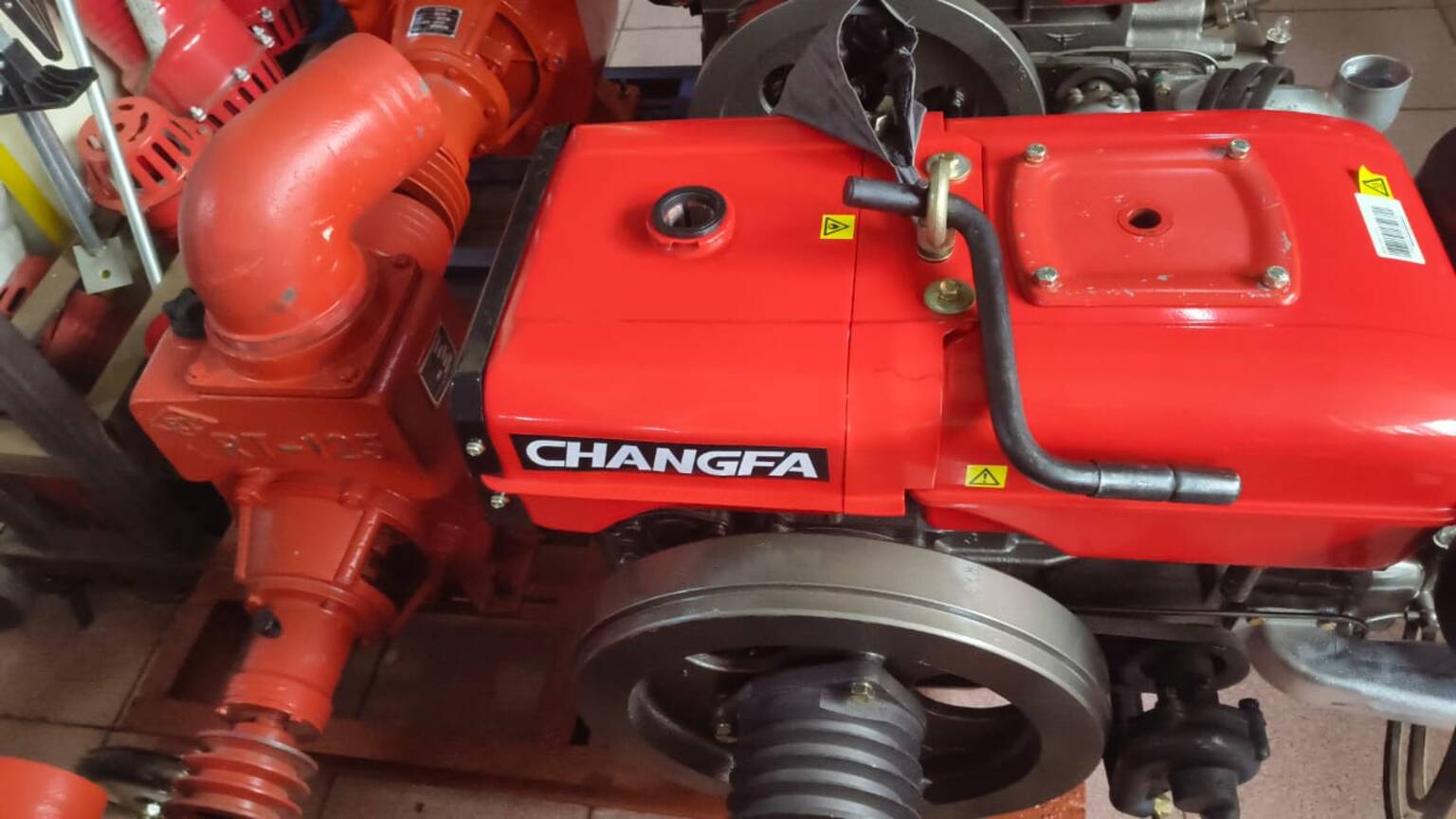
The image displays a self-contained industrial unit featuring a red Changfa diesel engine directly coupled to a matching RT-125 centrifugal water pump via a V-belt drive system. Designed for rugged, portable use in applications such as firefighting, irrigation, and flood control, this assembly functions as a prime mover that converts the engine's rotational power into hydraulic flow, with both components mounted on a wooden frame within a workshop or emergency response setting.
This image shows a Changfa diesel engine mounted directly to a red industrial water pump, forming a self-contained power unit — essentially a “pump-as-vehicle” setup where the engine drives the pump.
Key Components Visible:
Engine (Changfa Brand):
- The red engine block is clearly branded with “CHANGFA,” a well-known Chinese manufacturer of small to medium-sized diesel engines.
- It features a fuel filler cap, warning labels (yellow triangles), and a pull-cord starter handle on top — indicating it’s likely an air-cooled, single-cylinder or two-cylinder diesel engine designed for rugged, portable use.
- A large flywheel/pulley is visible at the front of the engine, which is critical for transmitting mechanical power.
Water Pump:
- Mounted to the left of the engine, this is a heavy-duty centrifugal water pump, painted red to match the engine.
- It has a large elbow inlet/outlet pipe (likely 4–6 inches diameter) and a volute casing typical of fire suppression, irrigation, or flood control applications.
- The model number “RT-125” is embossed on the pump housing — suggesting it’s a 125mm (approx. 5-inch) impeller pump, commonly used in firefighting or agricultural irrigation.
Drive Mechanism:
- Between the engine and pump, you can see a belts-driven connection. There’s a large pulley on the engine’s crankshaft (bottom center) connected via a V-belt to a matching pulley on the pump shaft (partially obscured but implied by alignment).
- This belt drive transfers rotational force from the engine’s crankshaft to the pump’s impeller, allowing the engine to “run” the water pump — i.e., convert fuel energy into hydraulic flow.
Mounting & Setup:
- The entire assembly appears mounted on a wooden pallet or frame, suggesting it’s either being prepared for transport, display, or field deployment.
- Background elements (other red pumps, tools, workshop environment) imply this is part of a fleet or inventory in a maintenance or emergency response facility.
In Context: “Engine to Run the Water Pump”
In this setup, the Changfa engine acts as the prime mover. When started (via the pull cord or electric starter, if equipped), it spins its crankshaft → rotates the drive pulley → tensions the V-belt → turns the pump’s impeller → draws water in through the inlet and expels it under pressure through the outlet.
This configuration is common in: - Firefighting units (portable fire pumps) - Agricultural irrigation systems - Flood control or drainage operations - Emergency water supply in remote areas
The design prioritizes reliability, portability, and direct coupling — no complex gearboxes or hydraulic systems needed. The engine size and pump rating are matched to ensure efficient operation within the engine’s optimal RPM range.
✅ Summary:
The image depicts a Changfa diesel-powered water pump unit, where the engine mechanically drives the pump via a belt system. This is a classic example of a prime mover + driven load arrangement, widely used in industrial and emergency services for moving large volumes of water reliably and simply.


 Telegram at username
@rcdrun
Telegram at username
@rcdrun WhatsApp Business