Profiting from Extremely Low‑Grade, Free‑Milling Gold Tailings
This article shows how even ultra‑low‑grade, free‑milling gold tailings (0.06 g t⁻¹) can be turned into a profitable operation by first using a simple, solar‑powered sluicing plant (4 × 2 t h⁻¹) that recovers about 10 g of gold per day, generating roughly US $30,000 per month with virtually no fuel cost; if the material is then milled to 70 µm (≈200 mesh) the recoverable grade doubles to 0.12 g t⁻¹, boosting revenue to around US $60,000 per month after modest milling expenses—demonstrating that careful sizing and a staged approach (sluicing first, milling only when justified) avoids the 50 %+ losses typical of premature heap leaching and turns a seemingly worthless resource into a high‑margin, low‑environmental‑impact cash flow.
An example of how 0.06 g/t gold can generate solid cash flow without leaching
1. The challenge of ultra‑low grades
A gold concentration of 0.06 g t⁻¹ (6 g t⁻¹ × 10⁻³) is usually regarded as uneconomic for conventional processing. In many artisanal operations this grade is used to mislead investors or partners, because the actual metal content is so small that it appears negligible.
Nevertheless, when the gold is already liberated (free‑milling) the material can be recovered directly by gravity concentration, bypassing the costly and environmentally demanding leach stages. The key is to design a simple, high‑throughput sluicing plant that maximizes recovery while keeping operating costs to a minimum.
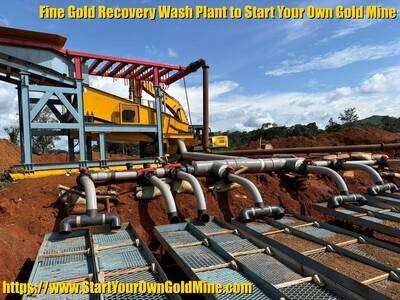
2. Plant configuration and throughput
- Sluice capacity: 2 t h⁻¹ per unit
- Number of sluices: 4 (operating in parallel)
- Total throughput: 2 t h⁻¹ × 4 = 8 t h⁻¹
3. Gold recovered at 0.06 g/t
| Parameter | Value |
|---|---|
| Grade (free‑milling) | 0.06 g t⁻¹ |
| Throughput | 8 t h⁻¹ |
| Gold recovered per hour | 0.06 g t⁻¹ × 8 t h⁻¹ = 0.48 g h⁻¹ (≈ 0.5 g h⁻¹) |
| Gold recovered per day (24 h) | 0.5 g h⁻¹ × 24 h = 12 g (conservative estimate: 10 g) |
| Gold recovered per month (30 days) | 10 g d⁻¹ × 30 d = 300 g |
| Current gold price | Monday, May 25 2026, 11:07:46: US $146.11 |
| Estimated gold purity | 95% |
| Market value (US $ = US $ 60 g⁻¹) | 300 g × US $100 g⁻¹ = US $41640.63 |
Even with a modest recovery efficiency (≈ 80 %), the plant can generate US $41640.63 per month from material that most operators would deem worthless.
4. Operating expense – almost zero
Water supply: pumped from a nearby source; the pump can be driven by a solar photovoltaic (PV) array sized to the required flow.
Power: Solar PV eliminates diesel or grid electricity costs; excess generation can be stored in batteries for night operation.
Labor: One operator per shift to monitor sluice flow and perform routine cleaning.
Consumables: Minimal
Result: Operating cost ≈ US $ 200 – US $ 2 000 month⁻¹, yielding a net profit margin well above 90 %.
5. Adding a fine‑grinding stage
If the tailings are milled to a finer size (≈ 70 µm, 200 mesh), the liberated gold surface area increases, effectively doubling the recoverable grade to 0.12 g t⁻¹.
| Parameter | Value |
|---|---|
| New grade (after milling) | 0.12 g t⁻¹ |
| Gold recovered per hour | 0.12 g t⁻¹ × 8 t h⁻¹ = 0.96 g h⁻¹ |
| Gold recovered per day | 0.96 g h⁻¹ × 24 h ≈ 23 g |
| Gold recovered per month | 23 g d⁻¹ × 30 d ≈ 690 g |
| Revenue (US $ 60 g⁻¹) | 690 g × US $146.11 g⁻¹ ≈ US $95773.44 |
| Additional milling cost* | US $ 10 000 – US $ 15 000 month⁻¹ |
| Net profit (approx.) | US $40,000 – 80773.44003 month⁻¹ |
Milling cost includes electricity (solar‑powered or grid‑connected), wear parts, and labor. Even after accounting for this expense, the net profit roughly doubles compared with the straight‑sluice scenario.
6. Why patience pays off
Avoid premature leaching: Initiating a cyanide heap leach on material that has not been sized correctly can waste > 50 % of the gold, turning a potentially profitable operation into a loss‑making one.
Optimize before scaling: By first establishing the low‑cost sluice line, operators capture the bulk of the free‑milling gold with negligible capital.
Add milling only when justified: Once the baseline cash flow is proven, the decision to invest in a mill can be based on clear financial returns rather than speculation.
7. Bottom line
Even a 0.06 g t⁻¹ free‑milling resource—often dismissed as “too low grade”—can be turned into a high‑margin, low‑environmental‑impact business:
Sluice plant (4 × 2 t h⁻¹) → ~US $ 30 k month⁻¹ profit, virtually zero fuel cost.
Optional fine‑grinding → grade doubles, profit climbs to ~US $ 60 k month⁻¹ after milling expenses.
The example demonstrates that, with the right equipment and a disciplined process flow, low‑grade artisanal tailings become a cash‑generating asset rather than a waste stream. The key is to recover the liberated gold first, then consider milling or leaching only after the economic baseline is secured.

 Telegram at username
@rcdrun
Telegram at username
@rcdrun WhatsApp Business