- Detailed Explanation of the Gold Mine Production Line #1
- 0, as well as various methods for hard rock mineral processing, all
- Transport of Ores to Mineral Processing Site
- Step 0. Unloading Ore from Truck to Feeder
- Step 1. Screening Process
- Step 2. Feeder Mechanism
- Step 3. Handling Oversized Rocks
- Step 4. Jaw Crusher Integration
- Step 5. Gravitational Transport to Impact Mills
- Step 6. Fine Gold Recovery via Sluices
- Step 7. System Efficiency and Cost-Effectiveness
- Step 8. Proven and Tested System
- Conclusion
- Transport of Ores to Mineral Processing Site
- Related pages
Detailed Explanation of the Gold Mine Production Line #1
We assist clients in launching their own gold mining ventures and engaging in small-scale mineral processing activities. For this purpose, we recommend our simplest gold production line, which we refer to as #1. Additionally, we offer alternative options, including
0, as well as various methods for hard rock mineral processing, all
designed to achieve the highest gold recovery rates. Our solutions cater to both small-scale operations and the largest mineral processing plants, ensuring optimal results for all types of projects.
Establishing an efficient and effective production line is crucial for the success of a gold mining operation. Below is a comprehensive explanation of the proposed production line, highlighting each component and its role in ensuring optimal gold recovery without unnecessary expenditure or delays.
The production line designates steps, machines, and methods for the recovery of gold, utilizing a combination of technology and expertise to maximize efficiency and minimize costs.
Transport of Ores to Mineral Processing Site
The first step involves transporting ores from the mine site, where excavation takes place, to the associated mineral processing site, whether it belongs to the same mine or a third party. We recommend that our clients set up only a mineral processing site if they face funding or resource constraints for large-scale gold mining operations.
Step 0. Unloading Ore from Truck to Feeder
When it comes to mining operations, efficiency is key. That’s why it’s essential that once rocks are extracted from mining sites, they are brought directly to the mineral processing site for further treatment.
One way to ensure maximum efficiency is to have trucks unload ore directly into the feeder.
This simple yet effective strategy eliminates the need for double handling, saving both time and labor costs. By having the truck unload the ore into the feeder, the material can be processed immediately without any delay, allowing for a smoother and more streamlined operation.
Additionally, this approach reduces the risk of damage or contamination to the ore, as it eliminates the need for unnecessary transportation and handling. Overall, having trucks unload ore directly into the feeder at the mineral processing site is a best practice that can greatly improve the efficiency and effectiveness of mining operations.
Step 1. Screening Process
The grizzly screens manufactured by Start Your Own Gold Mine are designed to be durable and practical, making them ideal for small-scale mining sites. They can be easily installed on-site, allowing for efficient rock classification and separation.
These screens are an essential part of the production line, as they help to ensure that only appropriately sized rocks proceed to the next stage of processing. By filtering out smaller particles, the grizzly screens contribute to the overall efficiency of the mining operation.
In this mineral processing line, screens are used to separate larger rocks from smaller ones. They are stationary and mounted as part of the feeder. The larger fraction needs to be broken down manually in order to pass through the screens and be ready for jaw crusher crushing.
Step 2. Feeder Mechanism
Following the screening, the material is transferred to the feeder. The feeder regulates the flow of rocks into the jaw crusher, maintaining a consistent and controlled feed rate. This consistency is vital for preventing overloading and ensuring that the crusher operates smoothly and efficiently.
The feeder in this version of the production line is a simple mechanical feeder, not an automated one. We utilize gravitational feeders to regulate the flow of rocks into the jaw crusher. This consistency is vital for preventing overloading and ensuring that the crusher operates smoothly and efficiently.
Step 3. Handling Oversized Rocks
During the screening process, some rocks may be identified as oversized. These larger rocks are diverted to one side, preventing potential damage or clogging in the crusher. Managing oversized material separately ensures that the main production line remains uninterrupted and operates at optimal capacity.
Oversized rocks are a common challenge in the mining industry. To address this issue, manual methods such as using a sledge hammer can be employed to break down the rocks into smaller, manageable pieces. This approach allows for more efficient processing and reduces the risk of damage to the crusher or other equipment. Additionally, separating oversized materials from the main production line can help maintain optimal capacity and prevent potential disruptions in the mining process.
Step 4. Jaw Crusher Integration
The core component of the production line is the jaw crusher. Properly sized rocks from the feeder are directed into the jaw crusher, where they are broken down into smaller, more manageable pieces. This reduction in size is necessary for the rocks to proceed to the next stage of processing.
A jaw crusher is a type of heavy machinery used in construction, mining, and industrial settings to break down large, solid materials into smaller, more manageable pieces. It is typically made up of two metal surfaces, one stationary and one mobile, which come together to crush material as it is fed into the machine. The size of the crushed material can be adjusted by changing the distance between the two metal surfaces. Jaw crushers are often used as the primary crushing equipment in a processing circuit and are known for their durability, reliability, and ability to handle high volumes of material. They can be powered by diesel or electric motors and are available in various sizes and capacities to suit different applications.
Step 5. Gravitational Transport to Impact Mills
Post-crushing, the smaller rock fragments are transferred by gravity from the jaw crusher to the impact mills. Utilizing gravity for this transfer eliminates the need for additional mechanical transportation, thereby saving both time and resources. The impact mills further pulverize the material, increasing the surface area for more effective gold recovery.
When considering methods for transporting ores on mineral processing site in East Africa, it is often more reasonable to avoid using conveyor belts and rather run on gravitational energy, as they tend to be more expensive to operate and less reliable in harsh environments. Instead, alternative transportation solutions that are better suited to the specific conditions and requirements of the region should be explored.
Particle Recirculation System
A particle recirculating system is used in gold recovery processes to ensure that larger particles that have not been adequately processed or that have not been fully liberated from the ore are returned back into the mill for further grinding and extraction. This allows for optimized gold recovery since the larger particles contain a higher concentration of gold.
One way to implement a particle recirculating system is through the use of a hydrocyclone. A hydrocyclone is a device that separates particles based on their density and size. In the gold recovery process, the hydrocyclone is used to separate the larger particles from the slurry or pulp that contains a mixture of water, crushed ore, and chemicals. The larger particles are collected and then reintroduced into the mill for further grinding. This ensures that the larger particles have more exposure to the milling process, increasing the chances of gold extraction.
Another method for particle recirculation is by using a spiral concentrator. A spiral concentrator is a device that uses gravity separation to separate particles based on their density. The slurry or pulp containing the larger particles is fed into the spiral concentrator, which consists of a helical trough. As the slurry flows down the spiral, centrifugal force and gravity cause the denser particles to move towards the outer edge of the spiral while the lighter particles move towards the center. The larger particles are collected at the outer edge and can be recirculated back into the milling process.
A wheel rotated mesh screen can also be used as a particle recirculating method. In this system, the slurry or pulp is fed onto a mesh screen that is rotating. The screen has apertures or holes in it that are sized to allow the finer particles to pass through while retaining the larger particles. The larger particles are collected and then returned back into the mill for further grinding and gold recovery.
Overall, these methods of particle recirculation, such as using a hydrocyclone, spiral concentrator, or wheel rotated mesh screen, ensure that larger particles that have not been fully processed are given more opportunities for extraction of gold, leading to optimized gold recovery.
Step 6. Fine Gold Recovery via Sluices
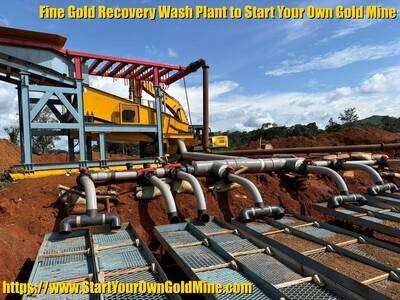
The finely milled material is then moved by gravity to the fine gold recovery sluices. These sluices are designed to capture and collect fine gold particles from the slurry. The gravitational flowensures a steady movement of material through the sluices, maximizing gold recovery rates.
Our fine gold recovery sluices efficiently recover virtually all visible gold of liberated particles, effectively eliminating any lossof liberated particles, with only gangue remaining. They are designed to recover particles down to an impressive 5 microns in size, a claim that has been substantiated through various studies and is open for our clients to verify. The movement of the finely milled material to the sluices is facilitated solely by gravity, ensuring a steady and continuous flow of material through the sluices, optimizing gold recovery rates.
Step 7. System Efficiency and Cost-Effectiveness
The entire production line is designed to be self-contained and gravity-fed, minimizing the need for external transportation between different processing stages. This integrated approach ensures that there is no wastage of money or time associated with moving materials over long distances or through multiple handling processes. By avoiding a neglectful or disorganized style of operation, the system guarantees a streamlined workflow that enhances productivity and profitability.
Once gold has been recovered, it can undergo two different processes: melting in ovens or furnaces to create ingots, or refining through the system that we offer to our clients. The refined gold can then be sold or utilized for additional manufacturing purposes.
Step 8. Proven and Tested System
The described production line configuration has been successfully implemented in similar mining projects. Its effectiveness is backed by practical usage, ensuring that investors and operators can rely on its performance without concerns of inefficiency or excessive costs. The system’s design prioritizes reliability and trustworthiness, making it a sound investment for sustainable gold mining operations.
Conclusion
Implementing this detailed and organized production line will facilitate a smooth and efficient gold mining process. By leveraging gravity for material transport, employing effective screening and crushing techniques, and utilizing proven recovery methods, the operation is set to achieve high gold recovery rates while maintaining cost-effectiveness. The systematic approach ensures that the mining team can work cohesively, enhancing overall productivity and success.
Related pages
- Detailed Explanation of the SYOGM Gold Mine Production Line #0
The SYOGM Gold Mine Production Line #1 is a basic hard rock production line that may be used before more serious stage of work during prospecting and initial days of the work.

 Telegram at username
@rcdrun
Telegram at username
@rcdrun WhatsApp Business