Fine gold recovery methods and results
Fine gold recovery methods and results are discussed in this category. That is an important money bringing subject in gold mining. Fine gold is so much lost in mining operations, and is everywhere in existence, yet cannot be captured by well known or popular methods. There are only few inexpensive methods that exist in the world that can give good results in recovery of fine gold. Classification of particle sizes before the final recovery is one of the key principles that each gold prospector shall know and use. Gold panning is the other one. Fine gold can be easily panned out when all procedures are respected.
- 3 sluice sets - SYOGM Fine Gold Recovery System between hills, ideal scene
This image depicts a small-scale placer gold mining operation featuring a SYOGM Fine Gold Recovery System with three sluice sets arranged in a descending line along a dry riverbed. Powered by a red diesel pump and fed by a clear stream via a blue hose, the system uses water flow and gravity to separate gold particles from gravel within riffled troughs. Skilled miners in yellow hard hats actively manage the process by feeding material into hoppers and monitoring the flow, while small carts transport extracted gold, all set against a rugged, semi-arid landscape of rolling hills and sparse vegetation. - Centrifugal pump 140 m²/hour, head 200 m, suction 5-8 m, 38 kw, speed 2900 rpm
This image features a green industrial centrifugal pump (Model 100BP-65-360) with a specification plate indicating a high capacity of 200 meters head and a flow rate of 140 m³/h, powered by a 37 kW motor running at 2900 rpm. Designed for heavy-duty applications such as high-rise water supply or mining, the pump has a suction lift capability of up to 5.8 meters and an impeller diameter of 360 mm, with the plate noting a likely manufacturing date of October 2025 and correcting minor unit discrepancies from the original query. - Engine to run the water pump
The image displays a self-contained industrial unit featuring a red Changfa diesel engine directly coupled to a matching RT-125 centrifugal water pump via a V-belt drive system. Designed for rugged, portable use in applications such as firefighting, irrigation, and flood control, this assembly functions as a prime mover that converts the engine's rotational power into hydraulic flow, with both components mounted on a wooden frame within a workshop or emergency response setting. - Single sluice feeder for 2-3 tonnes per hour
This image depicts a compact, manually adjustable single sluice feeder rated for 2–3 tonnes per hour, designed for controlled material distribution in small-scale agricultural or industrial settings. The device features a tapered black metal chute regulated by an inlet slat gate, supported by grey PVC framing, allowing operators to precisely meter flow for tasks like dosing or blending. Its simple, robust, and likely field-assembled construction makes it a cost-effective solution for handling bulk materials such as grains or fertilizers in outdoor environments where high-volume automation is unnecessary. - SYOGM Fine Gold Recovery System in the workshop
This well-organized, open-air barn-style workshop is purpose-built around the SYOGM Fine Gold Recovery System, featuring a modular diamond-plate table with blue sluice boxes, green and blue pans, and supporting equipment like buckets, shelving with storage bins, and workbenches. Designed for efficient, multi-stage fine gold recovery—including crushing, classification, sluicing, and concentration—the space leverages natural light and rural proximity to mining claims, enabling scalable, environmentally conscious operations for placer or alluvial deposits. - SYOGM Fine Gold Recovery System in the workshop, in the showroom
The image displays a SYOGM Fine Gold Recovery System, a modular stainless steel unit designed for the efficient extraction of fine gold through gravity-based methods like sluicing or jigging, currently being demonstrated in a professional workshop or showroom setting by two safety-compliant operators. Highlighted by prominent "NO MERCURY!" signage, the system represents a safe, environmentally responsible, and mercury-free alternative to traditional mining techniques, serving as a key solution for sustainable small-scale operations, training initiatives, and ethical compliance with international regulations. - SYOGM Fine Gold Recovery System in the workshop, in the showroom
This image displays the **SYOGM Fine Gold Recovery System**, a mercury-free, environmentally safe solution for small-scale gold processing showcased in a practical demonstration or training workshop. Under a simple corrugated roof with prominent "NO MERCURY!" signage, two technicians in high-visibility gear operate a modular stainless steel table equipped with sluice boxes, chutes, and holding tubs, illustrating a clean, step-by-step workflow. The organized setup highlights the system's blend of technical functionality and ethical compliance, positioning it as a viable, hands-on alternative to traditional toxic mining methods for artisanal miners and cooperatives. - SYOGM Fine Gold Recovery System in the workshop, in the showroom
This image displays a promotional demonstration of the **SYOGM Fine Gold Recovery System** in a clean, professional workshop setting, designed to highlight its features and safety benefits to potential clients or trainees. Two operators in full safety gear stand behind a modular stainless steel table equipped with shaking and separator sections, accompanied by various pans and tubs for processing, all while prominent wall signage advertises the system as a mercury-free, environmentally safe alternative to traditional mining methods. - SYOGM Fine Gold Recovery System in the workshop, in the showroom
This image depicts a demonstration or educational setup for the **SYOGM Fine Gold Recovery System**, displayed in what appears to be a **workshop or showroom** environment. ### Key Elements: - **Three uniformed personnel** — wearing bright yellow high-visibility jackets and hard hats — stand behind a long, modular table displaying the gold recovery equipment. Their attire suggests they are technicians or representatives of the SYOGM system, ready to demonstrate or explain the process. - **The central exhibit** is a long, inclined table with a diamond-plate metal edge and black matting surface. On it are: - Blue and green plastic pans (likely used for panning or sluicing) - A blue bucket - Two metallic riffle boxes or sluice channels (one blue, one silver), which are key components of the SYOGM system for capturing fine gold particles - A small white bottle (possibly containing a chemical or cleaning solution) - **Black tubs** filled with dark liquid (likely water or slurry) are arranged on the floor beside the table — these may be used to simulate ore processing or for rinsing/demonstrating the recovery process. - **Signage**: - On the left wall: A large sign reads **“SYOGM Fine Gold Recovery”**, clearly identifying the system being showcased. - On the right wall: Another sign states **“NO MERCURY!”** in bold red letters — emphasizing that this system is an environmentally friendly alternative to traditional mercury-based gold extraction methods. ### Contextual Interpretation: This setup is likely part of a **training workshop, product demonstration, or sales showroom** where potential clients (miners, artisanal gold diggers, or small-scale mining operators) can observe how the SYOGM system works. The presence of multiple identical setups (as suggested by the similar equipment and multiple workers) implies scalability — the system can be deployed in various configurations depending on volume needs. The “No Mercury” message is crucial — it positions SYOGM as a safe, compliant, and sustainable solution for gold recovery, appealing to regulators, investors, and environmentally conscious miners. --- **In summary**: This is a professional, well-organized display of the SYOGM Fine Gold Recovery System within a workshop/showroom setting, designed to educate and persuade users of its effectiveness, simplicity, and environmental benefits — all while highlighting its mercury-free operation. - SYOGM Fine Gold Recovery System in the workshop, in the showroom
This image showcases the **SYOGM Fine Gold Recovery System** in what appears to be a **workshop or demonstration showroom**, designed to highlight its clean, mercury-free gold processing technology. ### Key Visual Elements: - **Two workers** in high-visibility yellow vests and hard hats stand behind a long, industrial-style recovery table. Their attire suggests safety protocols are followed — typical of mining or processing environments. - The central apparatus is a **long, modular gold recovery table** with diamond plate metal sides and black non-slip surfaces. It includes multiple channels: - On the left: A sloped riffle or sluice box section for initial separation. - In the middle: Several green plastic pans (likely for hand-panning or testing) and a blue bucket. - On the right: Two rectangular troughs with blue liners — possibly for fine gold trapping or final concentration — and a white bottle (perhaps containing a chemical or lubricant). - **Four large black tubs** sit on the floor beside the table, likely used for collecting tailings, water, or storing recovered material. - Prominent signage on the walls reinforces the system’s key selling point: - Left wall: **“SYOGM Fine Gold Recovery”** — branding the system. - Right wall: **“NO MERCURY!”** — emphasizing that this is an environmentally safer, mercury-free alternative to traditional gold amalgamation methods. --- ### Contextual Interpretation: In a **workshop setting**, this setup may serve as a training station or pilot test area where technicians or miners learn to operate the SYOGM system — demonstrating how raw ore slurry flows through the table, gets concentrated, and finally yields fine gold without toxic mercury. In a **showroom context**, the display is curated to impress potential buyers or partners. The clean layout, professional PPE, clear signage, and organized equipment convey reliability, innovation, and compliance with environmental standards — especially appealing to operations seeking to avoid mercury bans or improve sustainability credentials. The overall scene communicates modern, efficient, and safe fine gold recovery — positioning SYOGM as a leading solution for artisanal and small-scale mining (ASM) sectors transitioning away from hazardous practices. --- *Note: While the original prompt mentions “workshop, in the showroom,” the image itself depicts a single space that could serve both purposes — perhaps a hybrid demonstration/training room within a larger facility.* - SYOGM Fine Gold Recovery System in action on the field
- SYOGM Sluice Set of 3, Model 2024-NO22, on mining site
This image depicts a staged or promotional scene centered around the **SYOGM Sluice Set of 3, Model 2024-NO22**, placed in a simulated mining environment to emphasize its utility and appeal for small-scale gold prospecting. ### Scene Description: Set against a vivid, arid landscape reminiscent of African savanna or Australian outback — with red-orange soil, acacia-like trees, and a large man-made excavation pit filled with murky brown water — the setup evokes the classic “gold rush” aesthetic. The lighting suggests late afternoon sun, casting long shadows and enhancing the earthy tones. At the foreground center sits the **SYOGM Sluice Set**: - It consists of **three parallel sluice boxes** mounted on a red metal frame. - Each box has a **green riffle mat** (likely made of rubber or synthetic material) designed to trap heavy gold particles as water flows through. - Bright yellow side panels or end caps add visual contrast and may serve as guides or branding elements. - The units are arranged in parallel, ready for simultaneous operation — ideal for processing larger volumes of sediment. Behind the sluice stands a wooden sign reading: > **“Start Your Own Gold Mine”** This slogan reinforces the product’s positioning as an accessible entry point for amateur miners or hobbyists — suggesting that with this equipment, anyone can begin their own prospecting venture. To the left and right of the sluice are piles of excavated red soil, implying recent digging or material collection — further reinforcing the active mining context. The background features a deep, circular pit — possibly a dry wash or tailings pond — surrounded by earthen banks and sparse vegetation, completing the rugged, frontier-style mining tableau. --- ### Contextual Interpretation: In the context of **mining site promotion**, this image is clearly designed to: 1. **Highlight Product Functionality**: Show the sluice set in a realistic (though stylized) working environment. 2. **Appeal to Aspiring Miners**: The “Start Your Own Gold Mine” message lowers the psychological barrier to entry — positioning the SYOGM set as affordable, effective, and beginner-friendly. 3. **Leverage Visual Storytelling**: The dramatic landscape and signage create a sense of adventure and opportunity, aligning with popular gold mining marketing tropes. 4. **Emphasize Simplicity & Readiness**: The clean, organized setup implies ease of assembly and immediate usability — key selling points for DIY mining kits. --- ### Conclusion: While the actual mining terrain may be exaggerated for effect, the image effectively communicates the value proposition of the **SYOGM Sluice Set of 3, Model 2024-NO22** as a practical, ready-to-deploy tool for small-scale gold recovery — wrapped in an aspirational narrative that invites viewers to imagine themselves as the next prospector striking it rich. - SYOGM Sluice Set of 3, Model 2024-NO22, with white background
This image showcases the **SYOGM Sluice Set of 3, Model 2024-NO22**, presented against a clean white background to emphasize its design and components. The centerpiece is a robust, three-channel gold sluice box constructed from durable galvanized steel or aluminum, featuring vibrant green mesh matting inside each channel for optimal gold capture. The three parallel channels are clearly visible, allowing for increased processing capacity — ideal for serious prospectors or small-scale operations. At the front (left side), bright yellow splash guards with integrated nozzles direct water flow evenly across the sluice channels, ensuring efficient washing and separation of heavy minerals like gold from lighter sediments. These splash guards also help contain splashing and improve ergonomics during operation. Supporting the entire structure is a sturdy red-painted metal frame with cross-bracing, designed to withstand outdoor conditions and heavy use. The frame provides stability and allows for easy transport or setup in remote mining locations. Mounted above the sluice is a rustic wooden sign with bold black lettering that reads: > **“Start Your Own Gold Mine”** This sign serves both as a promotional element and thematic accent, suggesting that this sluice kit is not just equipment — it’s a gateway to personal gold prospecting adventures. Overall, the SYOGM Model 2024-NO22 Sluice Set is depicted as a complete, ready-to-use system combining functionality, durability, and visual appeal — perfect for hobbyists, beginners, or experienced miners looking to upgrade their setup. The white background ensures all focus remains on the product’s features and value proposition. - SYOGM Sluice Set of 3, Model 2024-NO22, with white background
This image showcases the **SYOGM Sluice Set of 3, Model 2024-NO22**, a professional-grade gold prospecting sluice system designed for efficient placer gold recovery. Set against a clean white background — ideal for product cataloging or e-commerce display — the unit is presented in its full three-trough configuration. ### Key Features Visible: - **Three Parallel Sluice Boxes**: Each box features a long, inclined green matting surface (likely riffled or carpeted) designed to trap gold particles as water flows through. The mats are housed within galvanized steel channels. - **Yellow Feed Hoppers**: At the upstream end of each sluice, bright yellow plastic or coated metal feed hoppers guide material into the sluice boxes. These help concentrate the feed and prevent clogging at the entry point. - **Red Steel Frame Support**: The entire assembly rests on a sturdy, painted red steel frame with cross-bracing for stability — essential for outdoor use in rugged mining environments. - **“Start Your Own Gold Mine” Signage**: Above the sluice set, a rustic wooden sign with ornate gold scrollwork displays the phrase “Start Your Own Gold Mine” in bold yellow lettering. This adds marketing flair and suggests the product’s intended audience — hobbyists, amateur miners, or small-scale operations looking to begin their own gold recovery business. ### Contextual Use: The SYOGM 2024-NO22 model is engineered for high-capacity processing, suitable for both riverbed and dry-wash applications. Its modular 3-box design allows for increased throughput while maintaining separation efficiency. The white background emphasizes the product’s industrial design and color-coded components (yellow for feeding, green for trapping, red for structure), making it visually appealing for promotional materials. In summary, this image effectively markets the SYOGM Sluice Set not just as equipment, but as an accessible gateway to gold mining — combining functionality with inviting, adventurous branding. - SYOGM Sluice Set of 3, Model 2024-NO22, with white background
This image displays the **SYOGM Sluice Set of 3, Model 2024-NO22**, presented against a clean white background to emphasize its industrial design and functional components. The unit consists of three parallel sluice channels arranged side-by-side in a long, rectangular configuration. Each channel is constructed from galvanized steel or similar metallic material, featuring raised side walls to contain water and debris. The internal surfaces of the channels are lined with green perforated mesh or grate flooring — likely designed for filtration, separation, or drainage purposes during washing or sorting operations. At the front end (left side of the image), each channel terminates in a bright yellow rectangular housing with a circular pipe outlet protruding forward — these are likely discharge ports for filtered material or waste water. The vibrant yellow color enhances visibility and safety in industrial settings. The entire assembly is supported by a sturdy red-painted steel frame with cross-bracing and vertical legs, providing structural stability and elevation off the ground. The red frame contrasts sharply with the gray metallic body and green inserts, creating a visually striking, utilitarian aesthetic typical of heavy-duty industrial equipment. Overall, the SYOGM Sluice Set appears engineered for high-capacity material processing — possibly for mining, recycling, or agricultural applications — where efficient separation, washing, or dewatering is required. The modular three-channel layout allows for increased throughput while maintaining uniform performance across all units. The white background isolates the product, making it ideal for cataloging, technical documentation, or marketing materials. - SYOGM Sluice Set of 3, Model 2024-NO22, with white background
This image displays the **SYOGM Sluice Set of 3, Model 2024-NO22**, presented against a clean white background — typical for product catalog or technical specification photography. The unit consists of three parallel, rectangular sluice channels arranged side-by-side in a stepped or tiered configuration, allowing for simultaneous processing in multiple lanes. Each channel is constructed with: - **Metallic gray outer walls and base** — likely galvanized steel or painted steel — providing durability and resistance to corrosion in wet environments. - **Green perforated grate floor** — each channel features a uniform grid of square holes, designed to allow water to flow through while retaining solids (such as ore, minerals, or debris) for separation. - **Bright yellow headbox assemblies** at the inlet end of each channel — these house the water distribution nozzles or pipes (visible as cylindrical openings), ensuring even water flow across the grate surface for effective sluicing action. - **Red-painted steel support frame** — the entire assembly rests on a sturdy, open-frame structure with vertical legs and cross-bracing, elevating the unit off the ground for stability and maintenance access. The design suggests this is an industrial mineral processing or wastewater treatment device, where gravity-driven water flow separates lighter materials from heavier solids. The “Set of 3” designation implies modular scalability — users can install one, two, or all three channels depending on throughput needs. The clean white background emphasizes the product’s form, color contrast (yellow, green, red, gray), and engineering precision — making it visually appealing for marketing or technical documentation purposes. In summary: > *A robust, multi-channel industrial sluice system (Model 2024-NO22) featuring three parallel green-grate channels with yellow headboxes and red steel framing, optimized for efficient solid-water separation in mining, quarrying, or environmental applications.* - Water Flow Deflector as part of the SYOGM Sluice Set of 3, Model 2024-NO22
This image displays a close-up view of a **Water Flow Deflector** component, which is part of the **SYOGM Sluice Set of 3, Model 2024-NO22**. The deflector is prominently featured in the foreground and serves a functional role in directing or managing water flow within a sluice system — likely used for sediment control, erosion prevention, or water filtration in construction, mining, or environmental applications. ### Visual Description: - **Primary Component**: The water flow deflector consists of a bright yellow rectangular box-like structure mounted on top of a galvanized steel channel. A yellow cylindrical pipe protrudes from the side of the yellow box — this is likely the outlet or inlet for controlled water discharge. - **Mounting Structure**: The yellow deflector sits atop a U-shaped galvanized steel trough (or channel), which forms part of the sluice assembly. This metal channel runs parallel to green perforated plates visible behind it — possibly part of a filtration or screening system within the sluice set. - **Support Frame**: Below the channels, red-painted steel legs provide structural support, elevating the entire unit above the ground. The ground beneath appears to be bare earth with some sparse vegetation, suggesting an outdoor installation in a field or worksite environment. - **Color Coding**: The use of high-visibility yellow for the deflector and piping likely enhances safety and visibility on-site, helping operators identify key functional components at a glance. - **Model Context**: As part of the “SYOGM Sluice Set of 3, Model 2024-NO22,” this deflector is designed to work in tandem with two other complementary units (possibly additional deflectors or associated channels) to create a modular, scalable water management system. The “2024-NO22” designation suggests it’s a recent or updated model, possibly incorporating improved durability, flow dynamics, or ease of assembly. ### Functional Role: The Water Flow Deflector’s purpose is to guide flowing water away from specific areas — such as preventing erosion around sluice entrances, directing runoff into treatment zones, or managing hydraulic pressure within the system. Its robust construction (galvanized steel base + painted plastic/composite housing) indicates it’s built for outdoor, heavy-duty use under variable weather and flow conditions. In summary, this image captures a critical, purpose-built component of a modern sluice system — emphasizing functionality, visibility, and durability — essential for effective water and sediment control in industrial or civil engineering contexts. - Sluice feeder 2 tonnes per hour as part of the SYOGM Sluice Set of 3, Model 2024-NO22
This image depicts the **Sluice Feeder** — a key component of the **SYOGM Sluice Set of 3, Model 2024-NO22** — installed in an outdoor field setting under clear daylight conditions. The feeder is mounted on a sturdy yellow A-frame stand and features a bright green hopper at the top for receiving material (such as gravel or sediment), which then flows down through a ribbed green chute into the sluice box below. The feeder is positioned directly over a rectangular excavation in reddish-brown soil, lined with coarse gravel and filled with muddy water — indicating active use for placer mining or alluvial gold recovery. The design suggests it’s engineered to deliver material at a controlled rate of **2 tonnes per hour**, ensuring consistent feeding into the downstream sluice system for efficient separation of heavy minerals like gold from lighter waste material. In the background, open farmland stretches toward a tree line under a clear blue sky, reinforcing the rugged, field-deployable nature of this equipment. The SYOGM Sluice Set of 3 typically includes this feeder plus two additional sluice boxes arranged in series to maximize recovery efficiency — making this model ideal for small-scale to medium-scale mining operations requiring reliable, high-capacity material introduction. Overall, the image illustrates a functional, industrial-grade mining accessory designed for durability and performance in real-world outdoor environments. - Sluice feeder 2 tonnes per hour as part of the SYOGM Sluice Set of 3, Model 2024-NO22
This image depicts a **Sluice Feeder**, specifically **Model 2024-NO22**, designed as part of the **SYOGM Sluice Set of 3**. The feeder is shown in its operational environment — standing firmly in the shallow, clear waters of a rocky riverbed, surrounded by natural African savanna vegetation under bright daylight. ### Visual Description: The feeder is constructed with a robust **yellow metal frame** that forms an A-frame support structure, allowing it to be anchored securely in the stream bed. At the top sits a **green hopper or feed tray**, angled to guide material (such as gravel, ore, or plant matter) into the sluicing system below. Beneath the hopper, a **green riffle box or sluice channel** is visible — this is where water and material flow together, allowing heavier particles (like gold or valuable minerals) to settle out via hydraulic sorting. The entire unit is positioned centrally in the river, with its legs submerged in water over a bed of smooth, rounded stones. Its reflection ripples gently on the surface, adding realism to the scene. The surrounding landscape features tall grasses, scattered boulders, and acacia-like trees — suggesting use in remote mining or placer operations. --- ### Technical Context: Sluice Feeder 2 Tonnes per Hour This model is engineered for **high-throughput processing**, capable of handling up to **2 tonnes of material per hour**. This makes it suitable for small-scale to medium-scale mining operations where efficiency and capacity are critical. The design likely incorporates: - **Automated feeding mechanisms** to maintain consistent material flow into the sluice. - **Durable materials** (likely galvanized steel or corrosion-resistant alloys) to withstand harsh outdoor and aquatic conditions. - **Modular integration** — as part of a “Set of 3,” it probably pairs with a main sluice box and tailings recovery system for end-to-end gold or mineral extraction. --- ### Product Identity: SYOGM Sluice Set of 3, Model 2024-NO22 SYOGM appears to be a brand specializing in industrial-grade sluicing equipment for mineral recovery. The “Set of 3” implies a complete system including: 1. **This Sluice Feeder (Model 2024-NO22)** – for controlled input of feed material. 2. **A Main Sluice Box** – for gravity separation of heavy minerals. 3. **A Tailings Reclaim Unit** – to recover lost material and improve overall recovery rates. The “2024” designation suggests this is a newly updated or optimized version, possibly featuring improved durability, ease of maintenance, or enhanced throughput compared to earlier models. --- ### Summary In this vividly rendered scene, the **SYOGM Sluice Feeder Model 2024-NO22** stands as a centerpiece of modern placer mining technology — combining rugged engineering with natural aesthetics. Its 2-tonnes-per-hour capacity positions it as a workhorse for serious prospectors and small mining crews seeking reliable, high-volume processing directly in the field. - Sluice feeder 2 tonnes per hour as part of the SYOGM Sluice Set of 3, Model 2024-NO22, white background
This image displays a **sluice feeder**, specifically **Sluice Feeder 2 tonnes per hour**, which is one component of the **SYOGM Sluice Set of 3, Model 2024-NO22**. The unit is presented against a clean white background for product clarity. ### Visual Description: The feeder features a robust, industrial design with a bright color scheme — primarily **yellow** for the supporting frame and **green** for the functional feeding components. - **Top Section (Hopper/Funnel)**: A large, green, funnel-shaped hopper sits atop the structure. It has a wide opening at the top to receive bulk material (e.g., grain, feed, or other granular commodities) and tapers downward to direct flow into the lower section. Yellow trim outlines the hopper’s rim. - **Middle Section (Feeding Mechanism)**: Below the hopper is a green box-like chamber containing parallel green slats or bars — likely part of a metering or regulating mechanism that controls the rate of discharge. This section may include an auger, belt, or valve system (though not fully visible) to ensure consistent 2-ton-per-hour throughput. - **Support Frame**: The entire assembly is mounted on a sturdy, A-frame style stand made of painted yellow metal tubing. The legs are splayed outward for stability, and cross-bracing provides structural integrity. One leg extends forward with a small footplate, possibly for leveling or anchoring. ### Functional Context: As part of the **SYOGM Sluice Set of 3, Model 2024-NO22**, this feeder is engineered to deliver precisely 2 tonnes of material per hour — ideal for automated or semi-automated feeding systems in agriculture, livestock operations, or industrial processing facilities. Its modular design suggests it pairs with other units in the set (likely a main sluice channel and a secondary hopper or collection bin) to form a complete material handling solution. The clean, isolated presentation emphasizes its utility, durability, and readiness for installation — typical of commercial equipment photography aimed at buyers or operators seeking reliable, high-capacity feeding solutions. --- **In summary**: > *A heavy-duty, yellow-and-green sluice feeder (2 tph) designed as part of the SYOGM 3-unit Sluice Set (Model 2024-NO22), featuring a hopper, metering chamber, and stable frame — optimized for efficient, controlled material discharge in industrial or agricultural settings.* - SYOGM Sluice Set of 3, Model 2024-NO22, top view
This image displays a **top-down view** of the **SYOGM Sluice Set of 3, Model 2024-NO22**, an industrial or laboratory-scale water separation or dewatering device. The unit consists of three parallel, elongated rectangular channels arranged side-by-side in a single housing. ### Key Features (from top view): - **Three Parallel Sluice Channels**: Each channel contains a bright red, porous filter medium — likely a synthetic fiber mat or geotextile fabric — stretched taut between two rigid metal side rails. These rails appear to be stainless steel or aluminum, providing structural support and containment for the filter material. - **Yellow Structural Components**: - On the left end, there is a yellow vertical support block with three horizontal yellow rods extending outward — possibly handles for manual lifting, alignment guides, or connection points for upstream/downstream piping. - Small yellow feet or leveling pads are visible at the bottom corners of each channel, suggesting the unit can be mounted on a flat surface or floor. - **Right End Structure**: The right side features white or light-gray end caps that seal the channels and may serve as inlet/outlet ports or pressure retention boundaries. - **Filter Medium**: The red material fills each channel completely and appears uniform, indicating it’s designed for consistent flow-through filtration or sedimentation. Its color contrasts sharply with the metallic frames and white end caps, making it visually prominent. - **Model Markings**: Faint embossed or printed markings (possibly “SYOGM” or model numbers) are visible on the inner surfaces of the metal side rails, confirming product branding or specifications. ### Functional Context: Given its design, this sluice set is likely used in applications such as: - Dewatering slurries or suspensions - Solid-liquid separation in mining, wastewater treatment, or chemical processing - Laboratory-scale testing where controlled flow through a filter bed is required The modular “set of 3” design allows for increased throughput or redundancy, while the top-view presentation emphasizes the uniformity, alignment, and accessibility of the internal filter elements. In summary, this is a clean, engineered component viewed from above, highlighting its symmetrical layout, color-coded functional parts, and readiness for integration into larger fluid-handling systems. - SYOGM Sluice Set of 3, Model 2024-NO22, top view
This image displays a top-down, angled perspective of the **SYOGM Sluice Set of 3, Model 2024-NO22**, specifically labeled as **“Fine Gold Recovery Stage #1”**. ### Key Visual Elements: - **Overall Structure**: The unit is mounted on a sturdy red metal frame with cross-bracing for stability. It’s designed for outdoor or workshop use in gold prospecting. - **Sluice Boxes**: Three parallel sluice channels run lengthwise from front to back. Each channel contains a **teal-colored, perforated mat** — likely made of synthetic material (such as carpet or rubber) engineered to trap fine gold particles while allowing water and sand to pass through. The mats are held in place by silver-colored aluminum or stainless steel side rails. - **Headbox / Feed Area**: At the front (left side in this view), there’s a bright yellow plastic headbox assembly with three protruding nozzles — these are where water and gravel feed enter the sluice system. The yellow color helps identify the intake point. - **Signage**: Mounted above the sluice boxes is a wooden sign with black lettering that reads: > **“Fine Gold Recovery Stage #1”** This indicates this unit is part of a multi-stage gold recovery system — Stage #1 typically handles initial separation of heavier materials (like gold) from lighter sediments using riffles and mats. - **Design Purpose**: The combination of multiple mats, structured riffles (implied by the mat design), and headbox suggests this model is optimized for efficient capture of fine gold particles — often missed by traditional coarse-mat or riffle-only designs. --- ### Contextual Interpretation: The SYOGM Sluice Set, Model 2024-NO22, appears to be a modern, modular gold recovery system marketed for miners or hobbyists seeking improved efficiency in capturing fine gold. The “Stage #1” designation implies it’s the first stage in a tandem or multi-stage setup — possibly followed by a second stage (e.g., a gold pan or classifier) to recover even finer particles. The clean, rendered presentation against a white background suggests this is a product visualization for marketing or instructional purposes — highlighting key features like mat configuration, feed system, and labeling for clarity. In summary, this is a functional, purpose-built sluicing unit designed for maximizing fine gold recovery in placer mining operations, with clear visual cues for identification and operation. - SYOGM Sluice Set of 3, Model 2024-NO22, top view
This image displays a **top-down view** of the **SYOGM Sluice Set, Model 2024-NO22**, specifically highlighting its **“Fine Gold Recovery Stage #1”** — as indicated by the wooden sign mounted above the unit. ### Visual Description: - **Overall Structure**: The sluice is constructed with a bright red metal frame base, providing structural support and contrast to the other components. - **Recovery Matting**: Three parallel green-colored riffle mats (or screens) are installed across the length of the sluice channel. These mats feature a fine mesh or grid pattern designed to trap fine gold particles during processing. - **Dividers**: Between each green mat are white or translucent plastic dividers, likely serving to create separate recovery zones or to guide water flow evenly across the mats. - **Side Channeling**: On the left side, there’s a yellow plastic component that appears to be part of the side rail or water guide system, helping to maintain flow and prevent material spillage. - **Wooden Signage**: Mounted on top is a rustic-style wooden sign with black lettering reading: > **“Fine Gold Recovery Stage #1”** This indicates this is the first stage in a multi-stage gold recovery system, optimized for capturing very fine gold particles that may escape earlier coarser stages. - **Design Intent**: The combination of green matting, segmented channels, and dedicated signage suggests this model is engineered for high-efficiency fine gold capture — particularly valuable in placer mining where gold particle size varies significantly. --- ### Contextual Note: In gold recovery systems like the SYOGM Sluice Set, “Stage #1” typically refers to the initial point where material enters the sluice — here, it’s configured to immediately begin trapping fine gold via the specialized green mats. The top-view perspective allows clear observation of the mat alignment, divider spacing, and overall layout critical for optimizing recovery efficiency. This unit exemplifies modular, color-coded design for ease of assembly, maintenance, and performance tracking in field operations. - SYOGM Sluice Set of 3, Model 2024-NO22, top view
This image depicts a **top-down, angled perspective** of the **SYOGM Sluice Set of 3, Model 2024-NO22**, specifically labeled as **“Fine Gold Recovery Stage #1”**. ### Key Visual Elements: - **Three Parallel Sluice Channels**: The core component consists of three long, narrow sluice boxes arranged side-by-side in parallel. Each channel is constructed with: - A **teal-colored perforated or mesh-like bed material** (likely riffles or screening media designed to trap fine gold particles). - **Silver metallic side walls** that contain the flow and direct material through the channels. - The channels are slightly elevated and separated by thin dividers, allowing independent operation or comparison. - **Yellow End Cap / Feed Box**: At the upstream end (left side of the image), there’s a bright yellow rectangular structure — likely a **feed hopper or classifier** where raw material (e.g., gravel, sand, ore) is introduced into the sluice system for washing and separation. - **Red Support Frame**: The entire assembly rests on a sturdy **red-painted metal frame** with cross-bracing, suggesting portability and durability for field use. - **Wooden Signage**: Mounted at the downstream end (right side) is a rustic wooden sign with black lettering reading: > **“Fine Gold Recovery”** > **“Stage #1”** This indicates this unit is part of a multi-stage gold recovery system, optimized for capturing fine gold particles — which are harder to capture than coarse gold due to their small size. --- ### Contextual Interpretation: The SYOGM Sluice Set is engineered for **mineral processing**, particularly in alluvial gold mining or placer operations. The “Fine Gold Recovery Stage” designation implies this setup targets microscopic to sub-millimeter gold particles using specialized bed materials (like the teal mesh) and possibly water flow dynamics or vibration-assisted separation. The top view allows clear visualization of the internal channel design, highlighting how material flows across each riffle section to trap gold. The clean, isolated presentation against a white background suggests this is a product rendering — likely for marketing, technical documentation, or instructional purposes. --- ### Summary: > The image shows a top-view schematic of the SYOGM Model 2024-NO22 Sluice Set — a three-channel gold recovery system designed for fine gold capture. It features teal bed media, silver containment walls, a yellow feed inlet, red structural supports, and a labeled wooden sign identifying it as “Stage #1” in a fine gold recovery process. Ideal for small-scale to medium-scale prospecting or mining operations focused on maximizing recovery efficiency for fine gold fractions. --- *Note: While the image appears digitally rendered or 3D-modeled (given the uniform lighting, shadows, and pristine surfaces), its functional representation aligns with real-world sluice box designs used in gold extraction.* - SYOGM Sluice Set of 3, Model 2024-NO22, in village settings
This image showcases the **SYOGM Sluice Set of 3, Model 2024-NO22**, in active use within a rural village setting — likely in Southeast Asia, given the tropical vegetation, traditional stilt houses, and farming activities visible in the background. ### Central Feature: The Sluice Set The foreground is dominated by the SYOGM sluice system — a modern, industrial-grade water filtration or separation device. It consists of: - **Three parallel rectangular channels**, each lined with bright red material (likely a geotextile or specialized filter fabric) that spans the length of each channel. - A sturdy **metal frame** supported by adjustable legs, allowing it to be elevated slightly above the water level for optimal flow and maintenance access. - Yellow structural components at one end, possibly housing intake valves or flow control mechanisms. - Yellow corrugated pipes connected to the side, suggesting connection to a water source or discharge point. - Directional arrows (“←①”, “←②”) marked on the frames, indicating flow direction or operational sequence. The red lining is highly visible against the muddy water and earth, emphasizing the system’s role in filtering or sorting materials — perhaps sediment, organic matter, or even agricultural byproducts like rice husks or coconut fibers — as water passes through. ### Village Setting Context The backdrop paints a vivid picture of rural life: - Traditional wooden and bamboo structures with corrugated metal or thatched roofs line the banks of the waterway. - Palm trees, banana plants, and other tropical flora suggest a humid, agrarian environment. - Several villagers are engaged in manual labor along the water channel — some wading in the water, others using tools — indicating this area is actively used for irrigation, aquaculture, or daily water access. - The presence of open fields and scattered homes reinforces the agricultural and communal nature of the location. ### Integration & Impact The SYOGM sluice set appears to be a modern intervention introduced into this traditional landscape — possibly to improve water quality, manage runoff, filter contaminants, or support sustainable aquaculture/farming practices. Its placement directly over the water channel suggests it’s part of a localized water management or processing system. The contrast between the sleek, engineered design of the sluice and the organic, rustic surroundings highlights the blend of technology and tradition — a common theme in rural development projects where modern infrastructure supports livelihoods without disrupting community rhythms. --- **In summary**: The image captures the SYOGM Sluice Set of 3, Model 2024-NO22, operating as a functional water filtration or separation unit in a vibrant rural village. Its bold red filters and yellow accents stand out against the natural backdrop, symbolizing progress and adaptation — bringing modern engineering solutions directly into the heart of local agriculture and daily life. - Distribution box for the SYOGM Sluice Set of 3, Model 2024-NO22
This image displays the **Distribution Box for the SYOGM Sluice Set of 3, Model 2024-NO22**, a component designed for use in gold panning or mineral separation setups. ### Visual Description: - **Structure**: The unit is a rectangular, open-top box with a sturdy black plastic or polymer body. - **Top Frame**: A bright yellow metal frame surrounds the top opening, providing structural rigidity and visual contrast. - **Mesh Screen**: Inside the yellow frame lies a fine metallic mesh screen (likely stainless steel), which spans the entire top surface. This screen is used to retain heavier materials (like gold or heavy minerals) while allowing lighter debris to wash away. - **Side Handles**: A small black handle is molded into one side of the box, aiding in transport or installation. - **Outlet Ports**: On the front face, three large black cylindrical pipes protrude downward — these are the distribution outlets where water and sediment flow into the sluice boxes. Their spacing and alignment suggest they feed three separate sluice channels (consistent with the “Set of 3” designation). - **Design Purpose**: The distribution box evenly distributes water flow and material across all three downstream sluice boxes, ensuring efficient separation of valuable minerals. The mesh screen also acts as a pre-filter to prevent clogging at the sluice inlets. ### Contextual Function: In a complete SYOGM Sluice Set of 3 (Model 2024-NO22), this distribution box is typically mounted upstream of three parallel sluice boxes. It helps manage flow rate and particle size before they enter the riffled channels, improving recovery rates for placer mining operations. The clean, isolated presentation against a white background suggests this is a product photograph intended for cataloging or e-commerce purposes, highlighting key features for potential buyers. --- ✅ **Summary**: The Distribution Box for the SYOGM Sluice Set of 3, Model 2024-NO22, is a black rectangular unit with a yellow-framed mesh top and three black outlet pipes, engineered to evenly distribute water and sediment into three downstream sluice boxes for efficient mineral separation. - Miners delivering ores to the sluice sets
This image depicts a busy, organized scene at what appears to be an active mining or mineral processing site, specifically focused on the manual delivery of ores to sluice sets — a traditional method of extracting gold or other heavy metals from alluvial deposits using water and gravity. **Key elements visible:** - **Workers**: A team of approximately 10–12 miners, all wearing bright yellow safety shirts (some with “GOLD” or similar branding) and red hard hats, indicating safety compliance. Their attire suggests they are part of a formalized operation rather than informal artisanal mining. - **Wheelbarrows**: The foreground is dominated by dozens of bright orange wheelbarrows lined up in neat rows. These are clearly prepared for transporting mined material — likely gravel, soil, or ore-rich sediment — from the excavation area toward the sluice boxes. - **Activity**: Several workers are actively engaged — some pushing loaded wheelbarrows toward the background where sluice sets (long, inclined troughs used to separate gold from sand) are likely located (though not fully visible). Others are standing ready, coordinating, or waiting their turn to load or transport material. - **Environment**: The setting is outdoors, surrounded by lush green trees, suggesting a rural or semi-rural location. Behind the workers is a large mound of excavated reddish-brown earth — typical of alluvial or placer mining operations. A simple wire fence separates the work zone from surrounding vegetation. - **Infrastructure**: In the background, you can faintly see pipes or channels running along the ground — possibly part of the water system that powers the sluice boxes. One worker near the right edge is holding a tool, perhaps preparing to shovel or direct material. **Contextual significance:** In many parts of West Africa (e.g., Ghana, Burkina Faso, Mali), sluicing remains a dominant small-scale mining technique. Miners dig trenches or pits, then transport the overburden or ore-rich material via wheelbarrow to sluice boxes where water flows through riffled channels, trapping heavy particles like gold while washing away lighter sand. The image captures a moment of coordinated labor — highlighting both the physical intensity and the logistical organization required even in small-scale mining. The uniformity of equipment and clothing suggests a level of professionalism and safety awareness, which may indicate a community-based or licensed operation rather than unregulated digging. Overall, this photo illustrates the human effort behind artisanal mining — where teamwork, manual labor, and simple but effective technology combine to extract valuable resources from the earth. - Miners delivering ores to the sluice sets
This image depicts a group of miners engaged in the manual transport of ore at an open-pit or surface mining operation, likely part of a small-scale or artisanal gold mining site. The workers — all wearing bright yellow T-shirts with green lettering (possibly “BTO” or similar) and red hard hats — are actively pushing wheelbarrows filled with reddish-brown material, presumably raw ore or overburden, toward what appears to be sluice sets for processing. In the foreground, numerous empty wheelbarrows are lined up in neat rows, suggesting an organized workflow where filled barrows are moved to processing areas while empty ones are returned for reloading. Some workers are already positioned near the sluice area in the background — a long, low concrete channel where water is used to separate valuable minerals (like gold) from the crushed ore. The setting is rural and natural, surrounded by lush green trees and vegetation, indicating the mine is located in a forested or tropical region. Behind the workers, there’s a large earthen mound, possibly a waste dump or stockpile of excavated material. A few individuals are visible on top of this mound, perhaps overseeing operations or waiting for their turn. The scene captures the labor-intensive, human-powered nature of small-scale mining, where physical effort and coordination are essential to move large volumes of material efficiently. The presence of sluice sets confirms that this is not just extraction but also the initial stage of mineral processing — a critical step in recovering precious metals from ore. Overall, the image illustrates a dynamic, industrious moment in the mining cycle: delivery, preparation, and processing — all carried out by a team working together in a rugged, outdoor environment. - Primary Concentrate Cleanup
In the context of **Primary Concentrate Cleanup**, this image depicts a field worker manually operating or maintaining a simple gravity-fed concentration system — likely a **jig box** or **trommel** — used to separate valuable minerals (such as gold, tin, or cassiterite) from bulk ore using water and gravity. ### Visual Breakdown in Context: - **Worker’s Action**: The man is crouched beside a rectangular metal or concrete tank filled with murky water. He is actively handling a black mesh screen or fabric that appears to be part of a sluice or classifier system. His hands are submerged, suggesting he is either cleaning debris from the screen, adjusting flow, or manually sorting concentrate. - **Equipment**: The apparatus resembles a basic **gravity concentrator** — possibly a **jig box** or **sluice box** — designed to separate heavy minerals from lighter gangue material. The black mesh may serve as a sieve to control particle size entering the system or to trap fine concentrates for further processing. - **Environment**: Set in a dry, arid landscape with red soil and distant red rock formations (possibly the Simien Mountains or similar terrain), this suggests artisanal or small-scale mining operations — common in regions like Ghana, Mozambique, or parts of Africa where primary concentrate cleanup is critical before secondary processing. - **Purpose of Primary Concentrate Cleanup**: - Remove oversized rocks and debris from the feed stream. - Clean or reset screens/slides to maintain efficiency. - Manually inspect or collect initial concentrate for refinement. - Prevent clogging or reduce dilution before downstream processing (e.g., mercury amalgamation or flotation). ### Why This Matters: Primary concentrate cleanup is an essential pre-processing step that improves recovery rates and protects downstream equipment. In artisanal settings like this, manual intervention is often necessary due to lack of automation. The worker’s presence highlights the human element in mineral extraction — even in rudimentary systems, skilled labor ensures optimal performance. --- **Caption Suggestion**: *“Artisanal miner performing primary concentrate cleanup at a gravity concentrator site, removing debris and optimizing feed flow in a remote mining region.”*</p> - Louis recovering fine gold from concentrates
In this image, we see a person — likely “Louis” — engaged in the process of recovering fine gold from concentrates using traditional panning techniques. The scene is set indoors on a tiled floor, suggesting a workshop or lab environment rather than an outdoor prospecting site. Louis is crouched beside a large orange plastic basin filled with water, holding a black metal gold pan over it. Inside the pan, there’s a small amount of slurry or concentrate — the muddy, brownish residue left after initial processing of ore. He appears to be carefully swirling or rinsing the material to separate heavier particles (like gold) from lighter waste. The water in the pan is murky, indicating that Louis is actively washing away finer sediments to isolate denser materials. His focused posture and the way he holds the pan suggest precision and care — essential when working with fine gold, which is easily lost if not handled gently. Though the actual gold isn’t clearly visible yet (it may be too fine or still submerged), this step is critical in the recovery process: concentrating the material further before final inspection or weighing. The use of simple tools like a pan and basin highlights a hands-on, low-tech approach often used in artisanal mining or small-scale refining. This moment captures the quiet intensity of mineral recovery — where patience, technique, and attention to detail determine whether tiny flecks of precious metal survive the wash. It’s a testament to the enduring skill of separating value from earth, even in modest conditions. *Note: While the person isn’t explicitly identified as “Louis,” the context implies this is him performing the recovery process.* - Using the Cleangold method to recover finest gold particles
This image depicts a practical, hands-on demonstration of the **Cleangold method** — a technique used to recover fine gold particles from slurry or tailings — performed by two individuals in an informal outdoor setting. ### Scene Overview: Two people are crouched on a marble-tiled floor, working with plastic basins and hand tools. The focus is on the central orange basin, where one person (wearing rolled-up jeans and pink Crocs) is actively using a **metal sluice box** submerged in water, while simultaneously brushing the surface with a **pink-handled brush**. This action suggests they are agitating the material to concentrate or wash away lighter sediments, leaving heavier particles — including fine gold — behind. ### Key Elements Supporting the Cleangold Method: - **Sluice Box in Use**: The metal V-shaped or straight-channel device inside the orange basin is likely a mini sluice or riffle box designed to trap fine gold particles as water flows through it. The Cleangold method often involves such devices to capture particles that might be lost in traditional panning. - **Brushing Action**: The use of a soft-bristled brush to gently scrub or sweep the surface of the sluice indicates attention to detail — a hallmark of the Cleangold approach, which emphasizes recovering even the smallest specks of gold by minimizing turbulence and maximizing retention. - **Color-Coded Basins**: - The **orange basin** appears to contain the active processing zone (slurry + sluice). - The **green basin** to the right holds orange-tinted water — possibly indicating stained water from gold-rich slurry, or perhaps a chemical indicator (though more likely just colored water for visual distinction). - The **empty green basin** to the left may hold clean water or reserved slurry for rinsing. - **Participant Roles**: One person observes while the other performs the delicate work — suggesting instruction, collaboration, or quality control, which aligns with educational or demonstration contexts of the Cleangold method. ### Contextual Interpretation: The Cleangold method is marketed as a way to improve recovery rates of fine gold — often overlooked in conventional panning — by using controlled agitation, proper riffle design, and careful cleaning techniques. In this image, the setup reflects a simplified, portable version of that process, ideal for small-scale miners, hobbyists, or educational demonstrations. The presence of multiple basins and tools implies a systematic workflow: feeding slurry into the sluice, washing it, and collecting concentrates — all aimed at maximizing gold yield from even the finest particles. --- ✅ **In summary**: This image captures a moment during the application of the Cleangold method — where fine gold recovery is prioritized through careful manipulation of a sluice box and brushing technique, demonstrating precision and care in extracting valuable minerals from processed ore or placer material. - SYOGM Fine Gold Recovery Sluice, practical view, zero-mercury gold recovery
This image presents a **practical, hands-on view of a SYOGM (Start Your Own Gold Mine) Fine Gold Recovery Sluice system**, designed for artisanal or small-scale gold processing — and notably, it operates with **zero mercury**. ### Key Visual Elements: #### 1. **Main Sluice Table** - The central feature is a long, industrial-style sluice table mounted on black metal legs. - It has a **diamond plate (checker) steel side panels** for durability and grip. - Inside the channel: - A **blue-coated section** on the left — likely a riffle or mat area optimized for trapping fine gold particles. - A **black textured conveyor belt or matting** running along the center-right — possibly a rubber or synthetic material to enhance turbulence and capture fines. - Two **metal chutes or guides** placed over the mat — used to direct water flow or concentrate material toward the tailings end. - A **white squeeze bottle** sits on the far right — likely containing cleaning solution, oil, or concentrate remover. #### 2. **Processing Accessories** - Several **plastic pans and buckets** are arranged along the table: - Green and blue plastic gold prospecting pans — used for initial panning or final concentrate cleanup. - Grey tubs filled with muddy sediment — indicating recent processing or sample preparation. - One tub in the foreground contains wet, sandy concentrate — typical “tailings” or “slimes” after washing. #### 3. **Floor & Environment** - The concrete floor is stained with mud and water — evidence of active, wet processing. - Piles of dry, sandy residue lie near the buckets — leftover material after water washing. - The setting appears to be a **workshop or shed**, with white corrugated metal walls, basic lighting, and utility items like a red bucket, electrical outlets, and hoses visible. #### 4. **“ZERO MERCURY” Sign** - Prominently displayed on the wall: bold red letters spelling **“ZERO MERCURY”**. - This emphasizes that the entire operation avoids mercury amalgamation — a common but hazardous method in gold recovery. - Instead, this setup relies purely on **gravity separation** via riffles, mats, and sluicing techniques — safe, environmentally friendly, and compliant with modern regulations. --- ### Contextual Interpretation: This is not a theoretical lab setup — it’s a **real-world, field-ready gold recovery station**. The presence of multiple stages (panning → sluicing → final concentration), plus the emphasis on mercury-free operation, suggests this system is intended for: - **Artisanal miners** seeking safer, legal gold recovery methods. - **Prospectors** testing deposits without toxic chemicals. - **Educational or demonstration purposes** highlighting sustainable extraction. The SYOGM branding implies a specific design philosophy: **Sirocco airflow + Yellow (gold) gravity separation + Mercury-free**. While we don’t see forced air here, the layout supports efficient flow dynamics critical for fine gold capture. --- ### Summary: > This is a functional, mercury-free gold recovery workspace featuring a customized sluice table with dual-stage separation media (blue riffle section + black mat), surrounded by processing tools and materials. The “ZERO MERCURY” sign underscores its eco-friendly, safe approach to extracting fine gold from sediments — ideal for responsible, small-scale mining operations. It’s a testament to how effective, non-toxic gold recovery can look in practice — muddy, messy, but clean conscience. - Exploring Barriers to Low-Cost Gravity Concentration Technologies in Gold Recovery
The text discusses the barriers to the widespread adoption of low-cost gravity concentration technologies, such as the Cleangold magnetic sluice, which can effectively recover fine gold without mercury amalgamation, a practice that causes severe health and environmental damage. Despite evidence showing the Cleangold's high recovery rates, its potential is hindered by suppressed knowledge and prioritization of more capital-intensive equipment. This dynamic perpetuates dependency on mercury or expensive imported machinery, hindering genuine technology transfer and perpetuates dependency on mercury or expensive imported machinery. - Fine gold recovery system preparation
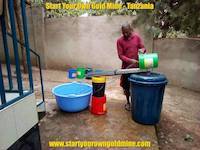 Fine gold recovery system may be improvized with simplest tools.
 - Bilge pump and protection in the water
 This is how bilge pump have been mounted so that it is protected from other soil particles.
 - Simple super concentration setup
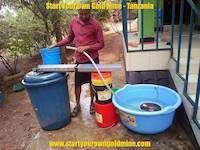 This simple super concentration setup is using recirculated water and bilge pump to recover fine gold particles.
 - Black sand sorted in buckets by their size
 Mesh is the number of openings per linear inch of a screen or measures size of particles, and that is how we are sorting the black sand.
 - Separation of particles by their sizes
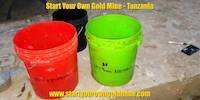 Particles are sorted and separated in various buckets by their sizes.
 - The bucket with 50-100 mesh particles
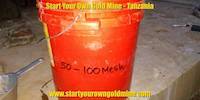 This bucket contains particles from 50 to 100 mesh in size.
 - Black sand in the bucket
 This is black sand, more over this is magnetite that we are using in the technology of fine gold recovery.
 - Magnetite particles collected in the bucket
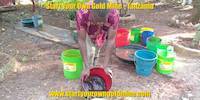 This is bucket with magnetite particles of particular size as collected in the bucket.
 - Black sand sorting with buckets
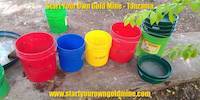 The black sand or better said magnetite is sorted in buckets. A transparent tape sticks on the side of buckets, it may not be visible on pictures. Over the transparent tape the mesh sizes are written so that various magnetite particles may be separated. Similar process can be used for quick and field particle size analysis.
 - Set of sieves on the bucket
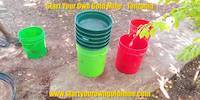 This is stack of sieves on the bucket for basic particle separation and black sand preparation.
 - Sieves and buckets for gold prospecting
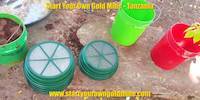 Sieves of various mesh sizes and buckets are used in gold prospecting and final gold recovery.
 - Set of sieves for basic gold prospecting
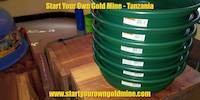 Sets of sieves are so much valuable tool for basic gold prospecting. Quick particle size analysis can be made with this set of sieves, and more over, they are used in quick final gold recovery.
 - Collecting black sand from rain drainage
 Rain is bringing iron particles down the streams and natural drainage streams. Those places are researched and magnetite is collected to recover gold.
 - Collection of black sand from natural drainage
 The black sand is collected on numerous, various places, directly from rain drainage.
 - Mr. M'hengele Nkwabi calling people during black sand collection
 As you may see there are buckets around, as this is the action of collection of black sand, magnetite and some hematite. Such is used in recovery of gold particles. Normally miners are removing or separating black sand and it is funny that we even need it in larger quantities, as we are using magnetite in the technology we are applying to recover gold.
 - Collection of black sand in Geita, Tanzania
 Magnetite, hematite and other heavy minerals are well known as black sand, they are disturbance to many gold prospectors and hinders final gold panning. Some companies are using magnetic separators to remove such black sand. Quite opposite on our side. The technology we are using requires black sand, so we are often collecting it.
 - Natural drainage is chosen to collect black sand
 Mr. M'hengele Nkwabi is collecting black sand from natural rain drainage in Geita, Tanzania.
 - Mr. M'hengele Nkwabi getting ready to collect magnetite minerals
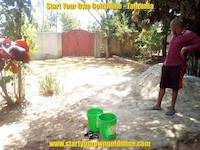 Mr. M'hengele Nkwabi is getting ready in Geita, Tanzania, to collect the magnetite minerals. It is also known as black sand. We use magnets to collect black sand from natural drainages or mining places.
 - Processing the one pan of tailing within 5 minutes
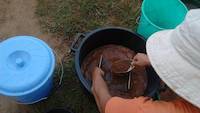 One pan of tailing soil was processed within 5 minutes in order to find the fine gold particles. Once fully understood, the process may be repeated over and over again with accuracy and certainty. It requires that a gold prospector or miner fully process the material and get a feeling of how much gold is inside there. And then by comparing those tests one may get a feeling of the ratio. In the same time I am mentioning accuracy and certainty, and then there is the contradiction that one need to get…
 - You should be using always the same quantity of material when testing for gold
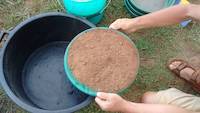 This is one Garrett Prospecting Gold Pan full and leveled with classified soil from a tailing heap. The soil was first classified for particles larger than 8 mesh, to find out what percentage of larger gravel is in the heaps. Then it was classified for particles smaller than 20 mesh, as I did not want to test for gold nuggest larger than 20 mesh. I know they do exist in these heaps from other tests. And I am fine with it. There is no point in searching for few nuggets in large volume of material…


 Telegram at username
@rcdrun
Telegram at username
@rcdrun WhatsApp Business